Wu Yuxiang (武禹襄) Taijiquan — Detailed Explanation
1. Historical Background (歷史背景)

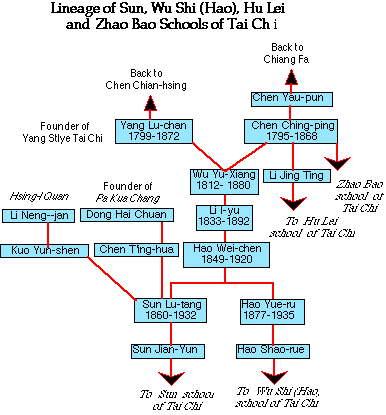

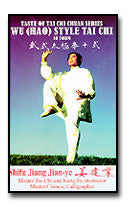
Wu Yuxiang (武禹襄, 1812–1880) is one of the most important theoretical founders of Taijiquan (太極拳).
He learned from:
Yang Luchan (楊露禪) → large frame Yang style (大架)
Chen Qingping (陳清萍) → small frame (小架) from Zhaobao (趙堡)
From these, he synthesized a refined internal system, later developed by his nephew Li Yiyu (李亦畬) and passed down as the Wu-Hao Style (武郝式太極拳).
👉 His greatest contribution is not only movement, but theoretical codification (拳論) — especially:
《太極拳論》 (Taijiquan Treatise)
《十三勢行功心解》 (Essentials of Practice of the Thirteen Postures)
《打手要言》 (Essentials of Push Hands)
2. Core Characteristics of Wu Yuxiang Style (武禹襄系統特色)
(1) Small Frame & Internal Precision (小架、內勁精細)


Movements are compact (小而精)
Emphasis on internal alignment (內在對齊) rather than external expansion
Every motion is controlled by dantian (丹田)
👉 Principle:
“以意行氣,以氣運身”
(Use yi 意 to guide qi 氣, and qi to move the body)
(2) Central Equilibrium (中定) as the Core
This is one of Wu Yuxiang’s greatest contributions.
The body revolves around a stable center: 中定 (central equilibrium)
Not leaning, not collapsing, not resisting
From classics:
「立身中正安舒」
(Stand centered, upright, and comfortable)
👉 In biomechanics:
Spine = vertical axis
Dantian = control center
Movement = rotation, not displacement
(3) Separation of Substantial and Insubstantial (虛實分明)
A key doctrine:
「虛實宜分清楚」
One side full (實), one side empty (虛)
Never double-weighted (雙重)
👉 Practical meaning:
In push hands (推手), avoid being “stuck”
Maintain dynamic adaptability
(4) Silk-like Internal Power (抽絲勁 / 內勁)

Wu Yuxiang emphasized continuous, unbroken force:
「運勁如抽絲」
(Moving energy like drawing silk)
Characteristics:
Continuous (連綿不斷)
Spiral (螺旋)
Elastic (彈性)
👉 Not brute force, but integrated body wave (整體波動力)
(5) Listening Energy — Ting Jin (聽勁)
One of the most advanced ideas:
「由著熟而漸悟懂勁」
(From familiarity, gradually understand energy)
Ting Jin (聽勁) =
Sensitivity to opponent
Detect intention before force manifests
👉 In modern terms:
Neuromuscular sensitivity
Micro-balance perception
(6) Non-Resistance Principle (不丟不頂)
From Wu Yuxiang tradition:
「不丟不頂」
Meaning:
Not losing connection (不丟)
Not resisting or opposing (不頂)
👉 This leads to:
Neutralization (化勁)
Borrowing force (借力)
3. Theoretical Depth — Integration of Daoism (道家思想)
Wu Yuxiang’s system is deeply rooted in:
Daoism (道家)
Yin-Yang theory (陰陽)
Yijing (易經)
Key concepts:
(1) Wuji → Taiji (無極 → 太極)
Stillness → movement
Potential → manifestation
(2) Yin-Yang Transformation (陰陽轉化)
Every movement contains its opposite
Attack = defense
Empty = full
4. Push Hands (推手) in Wu Yuxiang System

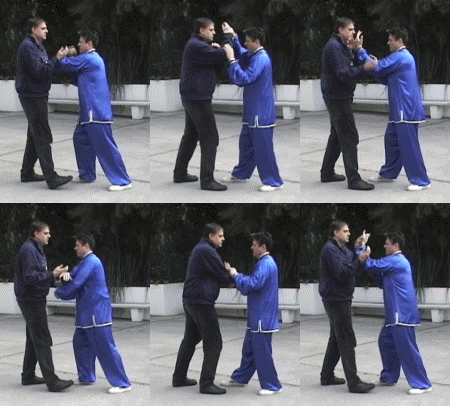
Wu Yuxiang’s push hands emphasizes:
(1) Connection (黏連)
Not “receiving force” directly
But connecting through structure
(2) One Dantian Concept (合一丹田)
Two persons → one interacting system
Whoever controls center controls movement
(3) Movement from imbalance
You don’t push → opponent moves due to imbalance
👉 This aligns with your earlier idea:
movement arises from balance disturbance, not force emission
5. Biomechanics Interpretation (現代力學觀)
Wu Yuxiang theory aligns closely with modern science:
(1) Ground reaction force (地面反作用力)
Force comes from the ground, not arms
(2) Kinetic chain (動力鏈)
Foot → leg → kua (胯) → dantian → spine → arms
(3) Center control (重心控制)
Movement = shifting equilibrium, not pushing
6. Unique Contribution Compared to Other Styles
| Aspect | Wu Yuxiang (武禹襄) | Yang Style | Chen Style |
|---|---|---|---|
| Frame | Small (小架) | Large (大架) | Mixed |
| Focus | Theory & precision | Flow & openness | Silk reeling |
| Energy | Subtle (細膩內勁) | Expansive (開展) | Spiral (纏絲) |
| Strategy | Neutralization | Structure + flow | Power + spiral |
👉 Wu Yuxiang = most “intellectual / refined” system
7. Essence Summary (總結)
Wu Yuxiang Taijiquan can be summarized as:
👉 “Centered awareness (中定), subtle internal control (內控), and transformation through connection (化於連接)”
Or in classical flavor:
「以靜制動,以柔克剛,以意運身」
If you want deeper exploration
I can further expand into:
🔹 Detailed breakdown of 《打手要言》 line by line
🔹 Comparison: Wu (武) vs Wu (吳) style differences
🔹 Advanced topic: Dantian merging (合一丹田) physics + Tai Chi classics
🔹 Application in your designated push-hands routine (指定推手對練)
Just tell me 👍