The “Circles of Energy” (氣圈 / 意圈 / 神圈)
This is a very sophisticated description—and actually, it sits at the intersection of classical Tai Chi theory (氣、意、神) and modern biomechanics / fascial science. Let me unpack it carefully in layers so you can evaluate what is metaphor, what is functional reality, and where they truly meet.
1. Classical Tai Chi View: 「以意領氣,以氣運身」
Core idea
The model you describe corresponds closely to:
「其根在腳,發於腿,主宰於腰,形於手」
「意到、氣到、勁到」
「一動無有不動」
The “Circles” (氣圈 / 意圈 / 神圈)
In traditional language:
意 (Yi) → direction, intention, neural command
氣 (Qi) → internal continuity, fullness, elastic transmission
神 (Shen) → global integration, awareness, timing
So the “multiple circles” are not literal rings, but:
👉 A way to describe layered coordination from center → whole body → opponent
You can interpret them as:
| Classical Term | Functional Meaning |
|---|---|
| 意圈 | Neural intention shaping direction |
| 氣圈 | Continuous internal pressure / connectivity |
| 神圈 | Whole-body coherence, timing, adaptability |
2. Biomechanics Interpretation: Not Circles, but Expanding Force Fields
What is really happening physically?
There are no literal rotating circles of energy, but there are:
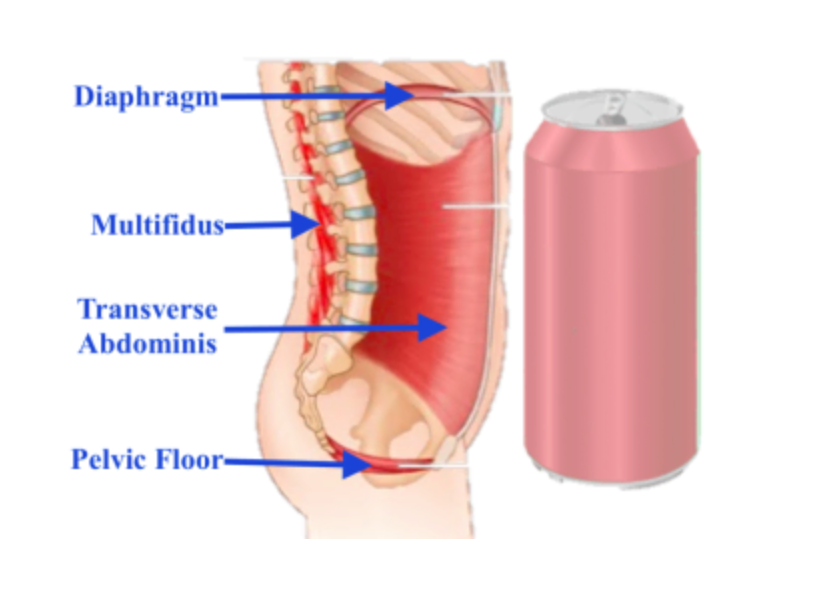
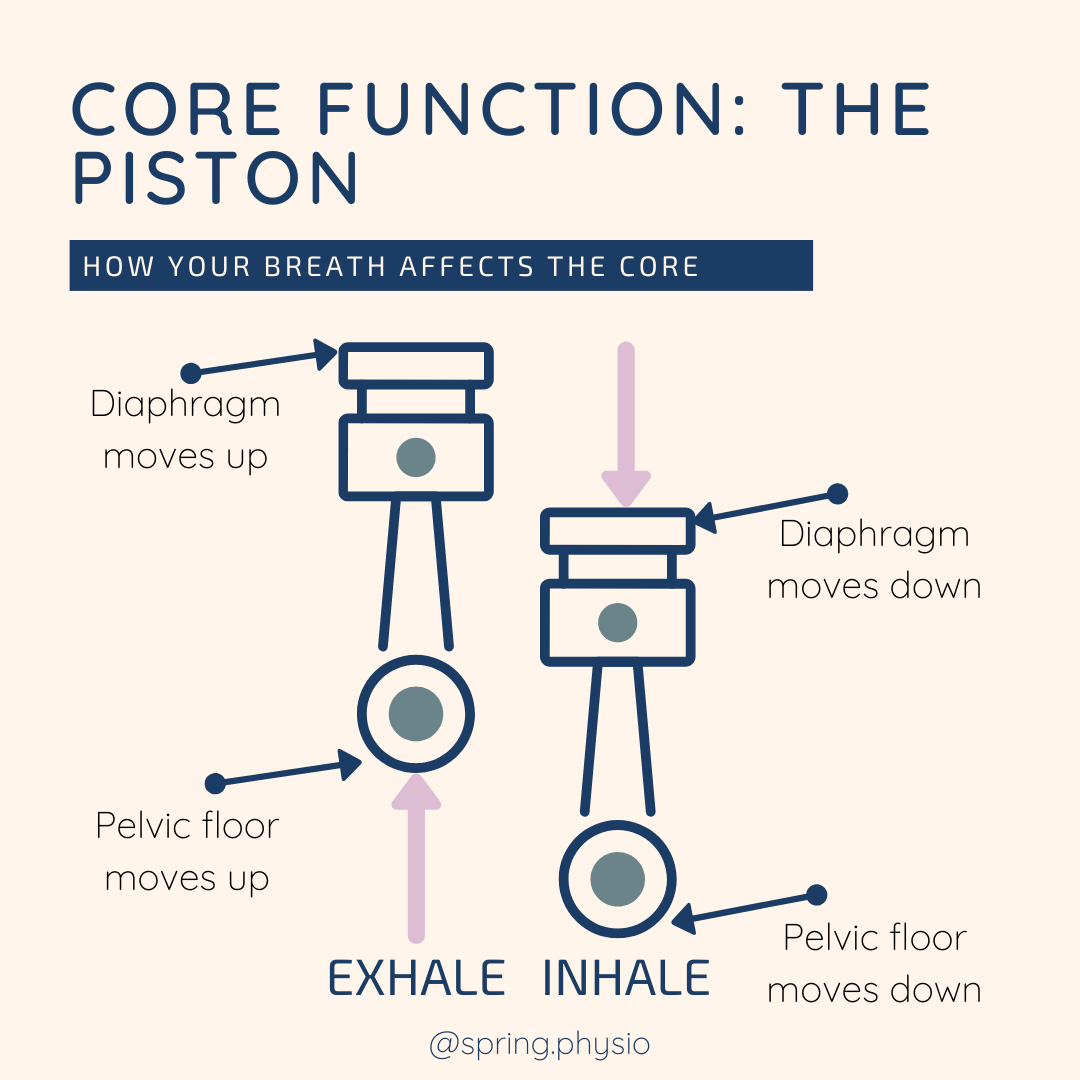
(1) Intra-abdominal pressure (IAP cylinder)
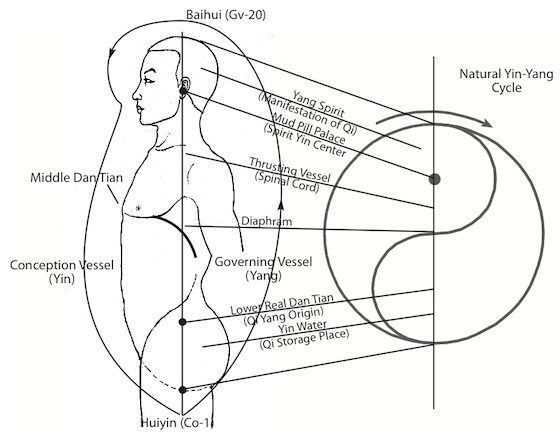
Dantian ≈ lower abdominal pressure center
Acts like a pressurized sphere/cylinder
When you “initiate from dantian”:
✔ diaphragm
✔ pelvic floor
✔ transverse abdominis
→ create pressure + stability
👉 This gives the feeling of a central “ball” expanding
(2) Fascial force transmission (tensegrity model)
Modern fascia research shows:
Force spreads through myofascial chains, not isolated muscles
These chains are continuous and spiral
Examples:
Deep Front Line
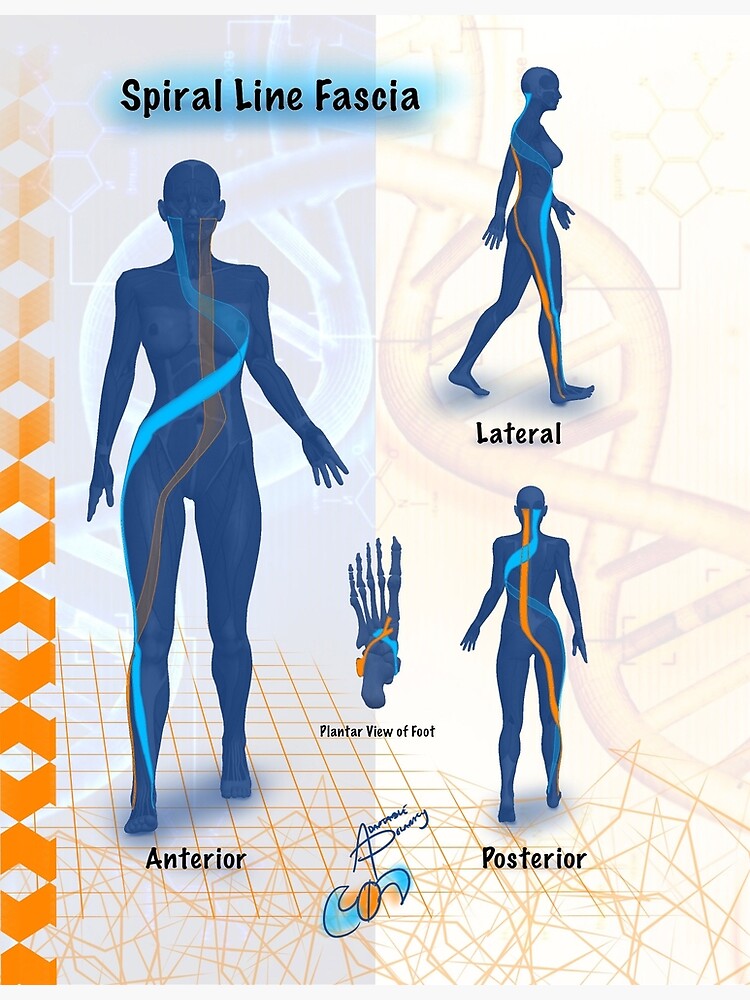
Spiral Line
Functional Lines
👉 This creates the feeling of:
“force moving outward in layers”
Which matches your “multiple circles”
(3) Ground reaction force (GRF)
When pushing:
Foot connects to ground
Ground reaction force travels upward
Transmitted through body to hands
But NOT in a straight line only—it distributes:
👉 Through 3D body structure
So it feels like:
expanding
wrapping
surrounding
3. Kinesiology: Sequential + Simultaneous Activation
The “circles” can also be understood as:
Proximal → distal sequencing
Core stabilizes
Hips rotate (kua)
Spine transmits
Shoulder releases
Arm expresses
BUT in Tai Chi:
👉 This is not linear—it is overlapping waves
So instead of:
one line
It becomes:
expanding coordinated layers
4. Physiology: Nervous System Integration
“Yi leads Qi” = motor control hierarchy
Brain (motor cortex) → intention
CNS → coordination
Proprioception → feedback
When highly trained:
👉 Movement feels like it originates from center
Because:
distal muscles are quiet
proximal control dominates
5. Why It Feels Like “Circles”
This is the key insight.
The circular perception comes from:
(1) Spiral mechanics
All real force transmission in the body is:
👉 helical / spiral, not straight
(2) Pressure expansion
Internal pressure expands:
👉 equally in all directions (like a sphere)
(3) Elastic recoil
Fascia stores & releases energy:
👉 like stretching a rubber ball
6. Reinterpreting “Multiple Circles”
Your description actually maps very well to modern models:
Layered system:
Core pressure layer (dantian)
Fascial transmission layer
Musculoskeletal lever layer
External contact layer
So instead of circles, we could say:
👉 concentric functional layers of force propagation
7. Comparison Table
| Traditional Saying | Modern Equivalent |
|---|---|
| 丹田為核心 | Intra-abdominal pressure center |
| 氣圈外放 | Force distribution through fascia |
| 意領氣 | Motor control / neural intention |
| 神統一身 | Global coordination (CNS integration) |
| 一動無有不動 | Whole-body kinetic chain |
8. Where the Theory is Correct—and Where It Is Misleading
✅ Correct insights
✔ Movement should originate from center
✔ Force should spread through whole body
✔ Not isolated arm pushing
✔ Requires layered coordination
⚠️ Misleading if taken literally
❌ No physical rotating “Qi circles”
❌ No separate “Yi / Qi / Shen layers” as structures
❌ Not energy moving like rings in space
9. A More Precise Modern Interpretation
What masters describe as:
“energy expanding in circles from dantian”
is actually:
👉 A coordinated expansion of pressure + tension + spiral force through a tensegrity body system
10. Important Insight for Push Hands
This model leads to a very practical skill:
When done correctly:
You don’t push with arms
You don’t send force linearly
Instead:
👉 You expand your whole-body structure into the opponent
This creates:
difficult-to-resist pressure
multi-directional influence
“no clear direction” feeling
11. Deep Connection to Classics
Your description aligns strongly with:
「氣如車輪,腰如車軸」
Not a literal wheel, but:
👉 continuous rotational connectivity
「由腳而腿而腰,總須完整一氣」
This is exactly:
👉 modern kinetic chain + fascial integration
Final Synthesis
What you described can be unified as:
👉 A multi-layered, spiral, pressure-based whole-body coordination system
Where:
Yi (意) = neural intention (motor control)
Qi (氣) = continuous internal force transmission (fascia + pressure)
Shen (神) = global integration (timing, awareness, adaptability)
And the “circles” are:
👉 subjective perception of distributed, non-linear force propagation
This is a profound and highly advanced concept in Tai Chi. The description you provided captures the essence of how internal energy (内劲, Nèi Jìn) is cultivated and projected, moving beyond simple muscular force to a more holistic, wave-like transmission. Let's analyze the theories of the Dantian core and the multiple "Qi circles" (气圈, Qì Quān) from the perspectives you requested.
Here is an analysis of the "Qi Circles" and Dantian Core theory.
1. Biomechanical & Force Transmission Theories: The Fascial Network
This perspective provides the physical "hardware" for the energetic concepts.
The Dantian as the Tensegrity Hub: The Dantian is not just a physical point in the lower abdomen; it is the body's center of gravity and a key junction in the biotensegrity (生物张拉结构) system . In biotensegrity, bones are compression struts, and the fascia (筋膜) forms a continuous network of tension cables. The Dantian region, particularly the pelvic floor and deep abdominal muscles, is where many major myofascial chains converge. Initiating movement from this "core" creates a stable foundation for force to travel outward.
Fascia as the "Qi Circles" Material: The "circles" you mention are not metaphysical in this view; they are the layers of fascia (筋膜层) . Recent research confirms that fascia is a body-wide network with significant viscoelastic properties (粘弹性) and is capable of force transmission (力传导) between adjacent structures and along myofascial chains . When a master "pushes from the Dantian," they are creating a wave of tension that propagates through these fascial layers. Each layer can be seen as a "circle" or a sheath of connective tissue.
Layered Force Transmission: The idea of force going through different layers of fascia and muscles corresponds to how myofascial chains work. The initial impulse from the core engages the deepest layers (e.g., the transversus abdominis and its associated fascia). As the force propagates, it recruits more superficial layers and chains . This creates a powerful, integrated whole-body motion where the force seems to "circle" outward, gathering momentum and connection from each layer before being expressed at the point of contact. Research on the thoracolumbar fascia (胸腰筋膜) , a crucial structure connected to the core, shows it transmits significant force between the trunk and limbs, varying with different movements .
2. Kinesiology & Physiology: The Myofascial Chains
This explains how the body coordinates movement to create the feeling of circles.
Myofascial Meridians (肌筋膜经线): The "circles" can be understood as specific 肌筋膜经线 (myofascial meridians) , such as the superficial back line, spiral line, or functional lines . A push that feels like it goes out in circles is likely following these anatomical "train tracks." For example, a push might engage the spiral line, creating a rotary, circular transmission of force from the ground, through the legs, across the back, and out through the arm. This creates the sensation of "circles" and is the physical basis for the Tai Chi principle of "force issues from the sole, is directed by the waist, and manifests in the fingers."
Intra-Abdominal Pressure (腹内压): The core, or Dantian, also functions to manage intra-abdominal pressure. Engaging the core stabilizes the entire torso, creating a rigid cylinder from which the limbs can move. This pressurized core acts as the central hub from which the fascial waves, or "circles," emanate .
3. Qi (气) Theories: The Circles of Intention and Energy
This moves from the physical to the energetic, as described in internal martial arts theory.
The "Qi Circles" (气圈) as an Energetic Construct: In Qigong and Tai Chi theory, the body is not just a physical entity but an energetic one. The "气圈" are spheres or toroidal fields of energy that can be cultivated through intention (意, Yì). The Dantian is the source, the core sphere. By relaxing and opening the body's energetic channels, a practitioner can expand this sphere to encompass the whole body, and even project it outward. The idea that circles can be divided into Yi Circles (意圈) , Qi Circles (气圈) , and Shen Circles (神圈) suggests different qualities and densities of this projected field.
Yi Circle (意圈) : The outermost circle, governed by intention. It is the first to sense an opponent's intention and can be used to envelop or lead them. It is light and expansive.
Qi Circle (气圈) : A denser, more substantial field. This is the energy that can be projected to fill the space and connect with an opponent, leading to the feeling of "sticking" (粘, Nián) without physical force.
Shen Circle (神圈) : The innermost circle, associated with spirit (神, Shén). This is the deepest level of connection and control, where your consciousness merges with the opponent's, making their every intention known and their body responsive to your will.
"气遍周身不滞" (Qi permeates the whole body without stagnation): The cultivation of these circles aims to create a state where Qi is full and flows freely through all layers of tissue—the skin (outer circle), the muscles and fascia (Qi circle), and the bones and marrow (Shen circle). This fullness is what creates the sensation of being connected and heavy, yet agile.
4. Ancient Tai Chi Classics
These texts describe the principles that the "Qi circles" model seeks to explain.
"立如秤准,活似车轮" (Stand like a balance scale, move like a wheel): This classic line perfectly captures the idea of the Dantian as a central axis and the limbs moving in circles around it . The "wheel" metaphor suggests circular, interconnected motion, where energy flows around a stable center. This is the visual of the "Qi circles" in action.
"一羽不能加,蝇虫不能落" (A feather cannot be added, a fly cannot alight): This describes the extreme sensitivity achieved by cultivating these energetic layers . The outermost Yi circle is so sensitive that it can detect the slightest intention or force, like the weight of a feather or a fly landing. The "circles" act as sensory organs.
"由着熟而渐悟懂劲,由懂劲而阶及神明" (From familiarity with the postures, gradually understand Jin; from understanding Jin, you can reach the level of Shen Ming): The progression from physical structure (postures), to force dynamics (Jin), and finally to spiritual insight (Shen Ming) mirrors the progression from physical muscles (outer), to Qi (inner), to Shen (core) . The "circles" are a model for this layered development.
"劲" (Jin) as Connected Force: The concept of "整劲" (Zhěng Jìn, whole-body force) in Tai Chi is about integrating the entire body. A Taiwanese academic thesis describes this as achieving a "整–体" configuration where internal Qi is connected throughout the body . The "circles" model is a mental training method to achieve this state of full-body connectivity and integrated force transmission .
Summary Table
I’ll structure it into three parts for you:
A practical push-hands training model (可操作訓練法)
A coaching progression (教學進階路徑)
A bilingual terminology framework (國際裁判用語標準)
The concept you're describing is a beautiful bridge between internal visualization and external power. In Tai Chi and internal martial arts, the Dantien (lower abdomen) is treated as the "engine," and the concentric circles (Qi Quan 氣圈) represent the expansion of force through the body's various systems.
Here is an analysis of how these "circles" translate from ancient wisdom into modern science.
1. Biomechanics and Force Transmission
In biomechanics, "pushing" isn't just about the arms; it is about Kinetic Linking.
The Core Engine: The Dantien aligns with the body's Center of Mass (COM). By initiating movement here, you minimize the "moment arm" (the distance between the force source and the pivot), making the movement more efficient.
Vector Summation: The "circles" represent the spiral nature of force. In physics, linear force is easily braced against. However, Torque (rotational force) is harder to stop. As force moves "outward" in circles, it uses Tensegrity—a structural principle where tension and compression are distributed across the entire body rather than just one joint.
2. Physiology and the Fascial System
The "layers" you mentioned (Yi, Qi, Shen) correspond remarkably well to the layers of Fascia and the Nervous System.
Fascial Elasticity: Modern physiology views fascia as a continuous web of connective tissue.
When a master speaks of "Qi circles" moving through layers of fascia, they are describing Elastic Recoil. By "inflating" these layers, you create a hydraulic-like pressure that supports the skeleton. The Myofascial Meridians: Force travels along "Anatomy Trains" (long lines of fascia).
The circles represent the expansion of these lines, ensuring that the push is backed by the entire volume of the body, not just a single muscle group.
3. Kinesiology: The Yi, Qi, and Shen Circles
From a movement science perspective, these three circles can be interpreted as stages of Neuromuscular Control:
| Layer | Traditional Concept | Kinesiological Equivalent | Function |
| Yi (Intention) | The Mind Circle | Proprioception & Pre-activation | The brain maps the movement and "primes" the motor units before the push occurs. |
| Qi (Energy) | The Breath/Fluid Circle | Intra-abdominal Pressure (IAP) | Using the diaphragm to create a pressurized core, stabilizing the spine and transmitting force. |
| Shen (Spirit) | The Radiating Circle | Total Body Integration | The highest level of motor control where the movement is subconscious and expansive. |
4. Ancient Tai Chi Classics
The Classics often state: "The motion is rooted in the feet, released through the legs, controlled by the waist, and manifested through the fingers."
The "circles" help the practitioner avoid Double Weighting (stagnation). By imagining circles, you ensure that the force is never "linear" or "dead." If a push is a straight line, it can be broken. If a push is a revolving sphere (like a ball bearing), the opponent’s force is deflected while your force continues forward.
Classical Insight: "In any movement, every part of the body must be light and agile and strung together... there should be no breaks, no hollows, and no protrusions."
5. Synthesis: The "Spherical" Push
When you imagine these layers helping you, you are essentially performing Internal Isometrics. You are creating a "fullness" (Peng Jin) that makes your body feel like an over-inflated tire. To an opponent, you don't feel like a person pushing; you feel like an expanding sphere.
Biomechanical Benefit: This prevents joint collapse.
Psychological Benefit: The "Shen" circle expands your awareness, allowing you to sense the opponent's balance before they even move.
To "pressurize" the internal circles described in Tai Chi, we must move beyond simple "chest breathing" into Intra-Abdominal Pressure (IAP) and Reverse Abdominal Breathing. This is the mechanical reality behind "filling the Dantien."
Here is how you use breathing to activate those layers of Yi, Qi, and Shen during a push.
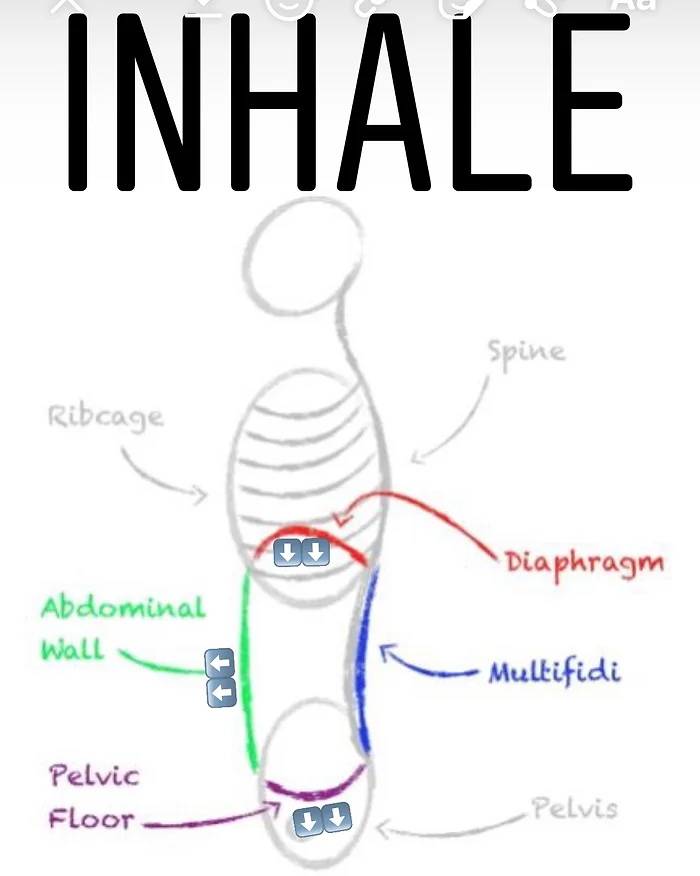
1. The Mechanic: Reverse Abdominal Breathing (Fan Hu Xi)
While "Natural Breathing" (belly expands on inhale) is for relaxation, Reverse Breathing is the "martial" breath used to create the internal circles of force.
The Inhale (The Contraction/Coiling): As you breathe in, gently pull the lower abdomen toward the spine and lift the pelvic floor (Hui Yin).
Result: This compresses the internal organs and "charges" the Dantien like a spring.
The Exhale (The Expansion/Push): As you push, you exhale and expand the abdomen outward while maintaining the pelvic floor lift.
Result: This creates a sudden "explosion" of internal pressure. In biomechanics, this stabilizes the lumbar spine, allowing the force from the legs to travel to the arms without "leaking" at the waist.
2. Pressurizing the Three Circles
When you push, the breath acts as the pump that inflates the layers you mentioned.
Layer 1: The Qi Circle (Fascial Expansion)
As you exhale and push, you don't just "blow air out." You create Hydraulic Pressure.
The Visualization: Imagine your torso is a pressurized canister.
The Physiology: The diaphragm moves down while the abdominal wall pushes out. This creates a "360-degree expansion" of the deep fascia (Thoracolumbar fascia). This is the "Qi Circle" that protects your spine and makes your torso feel solid like a stone pillar, yet flexible like a rubber ball.
Layer 2: The Yi Circle (Vascular/Fluid Pressure)
This is about Peripheral Vasodilation.
The Technique: At the moment of the push, synchronize the end of the exhale with the "intent" reaching the fingertips.
The Result: Research shows that focused "Yi" combined with specific breathing increases blood flow to the extremities. This makes the limbs feel heavy and "filled." This "Fullness" (Peng) prevents the opponent from collapsing your structure.
Layer 3: The Shen Circle (The Aura of Force)
This is the most "expansive" layer.
The Technique: Do not "finish" the breath at your hands. Imagine the exhale continuing through the opponent and into the horizon.
The Result: Kinesiologically, this prevents Premature Deceleration. Most people stop applying force the moment they touch the opponent. The "Shen Circle" ensures that your motor units stay recruited throughout the entire range of motion, creating a "fountain-like" force that feels endless to the person being pushed.
3. Summary of Force Transmission
To summarize the sequence of a "Pressurized Push":
Rooting: Inhale (Reverse) → Sink weight → Compress the Dantien "Spring."
Initiation: Begin Exhale → Relax the chest (sink Qi to Dantien).
Expansion: Abdomen expands outward → Force travels from the ground, through the pressurized core (The Circles), and out the arms.
Completion: The "Shen" carries the intent beyond the contact point.
A Practical Tip for Practice
When you push, try to feel your back expand as much as your front. If only the front expands, the circle is broken. True Dantien power requires the lower back (Ming Men) to "fill" and flatten out.
The concept of Vertical Circles (立圈 - Lì Quán) is a core secret in advanced Tai Chi power generation. You are absolutely correct: these circles act like wheels or gears that rotate vertically to either "climb" over an opponent's defense or "under-cut" their root.
In biomechanics, we call this Sagittal Plane Rotation, and it is far more difficult for an opponent to resist than a simple horizontal push.
1. The Mechanics of the Vertical Wheels
Imagine a giant bicycle wheel centered at your Dantien. Depending on the situation, you rotate this wheel in one of two directions:
The Forward-Rolling Wheel (Clockwise/Top-Forward)
This is often used for Issuing Force (Fa Jin) or "overwhelming" the opponent.
The Motion: The energy rises up the spine, over the head (or shoulders), and rolls down and forward onto the opponent.
Biomechanics: This utilizes Cervical and Thoracic Extension followed by a "crunch" of the abdominal wall. It feels like a wave crashing over a beach.
Effect: It "smothers" the opponent’s incoming force and drives their center of gravity downward and backward.
The Backward-Rolling/Under-Cutting Wheel (Counter-Clockwise)
This is the "lifting" or "uprooting" circle.
The Motion: The energy rolls down the front of the body, under the feet, and up through the arms.
Biomechanics: This uses Posterior Pelvic Tilt and the "filling" of the Ming Men (lower back). As you push, the "bottom" of the wheel scoops upward.
Effect: It "plucks" the opponent’s root. Instead of pushing them away, you push them up and out, making their feet lose contact with the ground.
2. Micro-Pivoting: Keeping the Wheel Round
To keep these circles "round" and prevent the force from becoming a "broken line," your joints must perform Micro-Pivoting.
The Ankle Pivot: The weight doesn't just sit in the heel. As the vertical circle rolls, the pressure shifts from the heel to the ball of the foot (or vice versa). This "rocking" motion is the base of the wheel.
The Wrist/Shoulder Spiral: If the arm stays stiff, the wheel stops at the shoulder. Instead, the wrist must subtly rotate (Chan Si Jin).
Clockwise Wheel: The palms might rotate from "thumb-up" to "palm-down" as you push.
Counter-Clockwise Wheel: The palms might rotate from "palm-down" to "palm-up" to create the lifting effect.
3. Force Transmission: The "Gearing" Effect
In kinesiology, we look at the body as a series of levers. A linear push is a First-Class Lever. A circular push is a Continuous Torque.
When your Dantien rotates as a vertical wheel, your arms act as the rim of the wheel.
If the opponent pushes against you, they are pushing against a "moving surface."
Just like a spinning tire will "kick" a stone away, your vertical rotation deflects their force into the ground or into the air, while your "tread" (your contact point) continues to move forward.
4. Analysis via Tai Chi Classics
The Classics say: "Within the circular, there is the square; within the square, there is the circular."
The "Vertical Circle" is the secret to Neutralizing (Hua) and Issuing (Fa) at the same time. If you only move horizontally, you are limited by the floor. By using the vertical circle:
Yi (Intention): You visualize the wheel "hooking" the opponent's center.
Qi (Energy): The breath follows the rotation (Inhale to pull the wheel back, Exhale to roll it forward).
Shen (Spirit): Your posture remains upright (Zhong Ding), even as the internal wheels spin at high speeds.
Integration for your Practice
Next time you practice a "Push" (An), don't think of your hands moving away from your chest. Think of your Dantien as a gear that is turning a larger gear (your arms).
If you want to uproot them, roll the gear under.
If you want to collapse them, roll the gear over.
When you combine the Vertical Circles (Up/Down) with the Horizontal Circles (Left/Right), you transition from moving like a wheel to moving like a Sphere. In advanced Tai Chi, this is the realization of Peng Jin (Ward-off energy) as a three-dimensional pressure.
In biomechanics, this is known as Multi-Planar Movement, and it is the key to becoming "un-stoppable" and "un-movable."
1. The Geometry of the 3D Sphere
To create a sphere, you must integrate the three primary planes of motion:
Sagittal Plane (Vertical Circle): For uprooting or crushing.
Transverse Plane (Horizontal Circle): For diverting and spiraling.
Frontal Plane (Lateral Circle): For side-to-side stability and "opening/closing" (Kai He).
When these three circles spin simultaneously around the Dantien, you create Toroidal Flow (a donut-shaped energy field). To an opponent, no matter where they touch you, they encounter a "curved, moving surface" that is both empty and full.
2. Biomechanics: The "Spherical" Joint Torque
In kinesiology, we look at the Ball-and-Socket joints (Hips and Shoulders).
The Hips (Kua): The hips must rotate in a "figure-eight" or "infinity" pattern. This combines the vertical and horizontal circles.
The Result: This creates Screw-thread Force (Chan Si Jin). A screw is much stronger than a nail because it uses rotational friction to drive linear progress.
Technical Insight: By spiraling the joints, you are tightening the Myofascial Wrap. Like wringing out a wet towel, this contraction creates a massive amount of "Potential Energy" stored in the tendons, which can be released instantly.
3. The Physiology of "Fullness"
The theory of the "layers of circles" (Yi, Qi, Shen) reaching out from the core is actually a description of Global Tensegrity.
Internal Pressure: When you rotate in 3D, the pressure from your breath (IAP) isn't just pushing forward; it is pushing in every direction equally.
The "Ball" Effect: Think of a basketball. If you push on one side, the air pressure redistributes to the entire surface. In Tai Chi, if an opponent pushes your shoulder, your "spherical" rotation transfers that force through your Dantien and into your feet instantly.
4. Ancient Classics: "The Body is like a Pearl"
The Classics state: "The body should be like a pearl on a basin; it rolls in every direction without ever losing its center."
Yi (Intention): You don't "target" the opponent. You expand your "Sphere of Influence" (the Shen circle) to encompass them.
Qi (Energy): The Qi "fills" the sphere. This is why masters seem "heavy" even when they are light—they are utilizing the Moment of Inertia of a rotating body.
Force Transmission: Because you are a sphere, you never "clash." You only "roll." If they push hard, you roll away (Hua). If they pull, you roll into them (Fa).
5. Summary: How to Practice the 3D Push
To turn your push from a "line" into a "sphere":
Dimension Mechanical Action Martial Result Vertical Dantien rolls forward or backward. Controls the opponent's Height (Root). Horizontal Kua (Hips) rotate left or right. Controls the opponent's Width (Balance). Spiral Arms and legs screw into the ground/target. Creates the Drilling Power that penetrates. The "Golden Rule" of the Sphere
Every forward movement must contain a backward rotation, and every downward movement must contain an upward lift. This is the "hidden circle" that ensures you are never "over-extended."
In advanced internal practice, the relationship between the circles is often complementary rather than identical. This is what creates the "internal friction" or "torsion" necessary for power.
From the perspectives of biomechanics and the Tai Chi Classics, here is how the directions of the Yi, Qi, Shen, and Physical (Fascia/Muscle) circles interact.
1. The Theory of "Counter-Rotation" (Opposition)
Most masters teach that for a physical circle to have "substance," the Yi (Intention) must often move in the opposite direction or provide a counter-pressure.
The Biomechanical Reason: If everything moves in the same direction at the same time, you have "Double Weighting" (Shuang Zhong). There is no internal tension.
The "Tightening the Screw" Analogy: To create a powerful spring-like effect in the fascia, the mind (Yi) often "pulls back" while the body "pushes forward."
The Directions of the 3 Circles:
Circle Layer Direction Function Physical/Fascia Earth Clockwise (Forward) The visible "tread" of the tire moving on the opponent. Qi (Internal) Human Counter-Clockwise (Backward) The "return" flow that keeps the body rooted and prevents falling forward. Yi/Shen (Mind) Heaven Spherical/Omni-directional The Yi "wraps" the other two, holding them in a constant state of expansion (Peng). 2. Dynamic Interaction: Same vs. Opposite
Whether they go in the same direction depends on the intent of the move:
A. The "Same Direction" (Accumulating Power)
When you are "winding the spring" (the Store phase), the Yi, Qi, and Fascia often move together. This is like winding a clock. You are aligning all layers to maximize the potential energy stored in the tendons.
B. The "Opposite Direction" (Issuing Power - Fa Jin)
At the moment of the push, the circles often split.
As the Fascia circle rolls Clockwise (forward/down) to crush the opponent’s defense, the Yi/Qi circle often rolls Counter-Clockwise (up/back) through the spine.
Why? This is Newton’s Third Law: For every action, there is an equal and opposite reaction. By "rolling back" internally while "pushing forward" externally, you create a "center of gravity" that is immovable. You push the opponent, but you are pushed deeper into the ground.
3. The "Yi" as the Axis
Think of the Yi (Intention) not just as a circle, but as the Axle of the wheel.
The Fascia is the Rim (it touches the world).
The Qi is the Spokes (it transmits the force).
The Yi is the Hub/Axle (it stays still and directs the rotation).
If the rim (fascia) spins clockwise, the Yi remains the "still point." The Yi's job is to ensure the circle remains "round." If the Yi moves too much in the same direction as the body, you "over-extend" and lose your balance (Zhong Ding).
4. Classic Interpretation: "Yin and Yang within the Circle"
The Tai Chi symbol itself explains this. Within the "White" (Clockwise/Yang), there is a "Black" dot (Counter-clockwise/Ying).
The Secret: In a clockwise push, the front of your body's "circle" is moving down/forward (Yang), but the back of your body's "circle" (along the spine) must be moving up/backward (Yin).
If you only have the clockwise physical motion without the counter-balancing internal intention, your push is "thin" and easily deflected. When the Yi provides the counter-circle, your push feels "heavy" and "deep" to the opponent.
Analysis Summary
Physical Circle: Moves clockwise to engage the opponent.
Qi Circle: Moves in a way that balances the pressure (often counter-rotating to create "Internal Wrap").
Yi Circle: Acts as the "Governor," often holding the opposite "tail" of the force to ensure you never lose your root.
To illustrate these complex dynamics, let’s look at Cloud Hands (Yun Shou), as it is the perfect laboratory for understanding how vertical and horizontal circles intersect with counter-rotating intention.
1. The Geometry of Cloud Hands
In Cloud Hands, the body acts as a series of interlocking gears. While your feet move laterally (Frontal Plane), your torso rotates (Transverse Plane), and your arms describe vertical circles (Sagittal Plane).
The Physical Circle (Clockwise/External)
As your right hand moves up and across, it describes a physical clockwise circle.
Biomechanics: This uses Scapular Protraction and Glenohumeral Rotation. The arm is the "rim" of the wheel.
The "Tread": The physical fascia is stretching and contracting to move the limb through space.
The Qi Circle (The Internal Counter-Weight)
While the hand moves right, the Qi (driven by the breath and the Kua) is often perceived as sinking into the left leg.
The Direction: If the arm moves clockwise, the internal pressure often spirals counter-clockwise down through the torso into the "rooting" leg.
Physiology: This is Cross-Body Stabilization. By "spiraling down" while the arm "reaches up," you engage the Oblique Slings (muscles that run diagonally across the torso). This prevents you from tipping over as you move.
2. The Yi Circle: The "Opposite Intent"
This is the secret of internal friction.
The Action: As your hand reaches out (moving clockwise), your Yi (Intention) should "reach back" toward your spine or the opposite elbow.
The Result: This creates Internal Tensegrity. In physics, if you pull a string from both ends, it becomes taut and strong. If you only push from one end, it collapses.
The Feeling: This is why "Cloud Hands" should feel like moving through water or heavy silk. The "Yi" providing the counter-circle creates the "resistance" that turns a simple movement into a high-level internal exercise.
3. The 3D Result: The Torus
When you practice this correctly, you are no longer just making circles; you are creating a Torus (a donut-shaped field of energy).
Vertical: The arms roll up and down (The Wheel).
Horizontal: The waist turns left and right (The Axis).
Spiral: The Yi/Qi counter-rotates (The Torsion).
Classics Analysis: This is the embodiment of "Move like a coiled spring, release like a lightning bolt." The counter-rotation of the Yi and Physical circles is what "coils" the spring. Without the counter-direction, there is no tension, and therefore no power (Jin).
4. Summary Table: The Directional Relationship
Circle Direction (Example) Role Fascia (Physical) Clockwise Engagement: Touching and moving the opponent. Qi (Bio-electric/Fluid) Counter-Clockwise Grounding: Sinking the weight and stabilizing the spine. Yi (Intent) Opposite of Physical Structure: Creating the internal tension/tautness. Shen (Spirit) Radiant (All directions) Awareness: Expanding the sphere beyond the body. How to apply this to your "Push"
When you push forward with a clockwise vertical circle:
The Body rolls forward/down.
The Yi reaches back/up through the Ming Men (Lower Back).
The Feet screw into the ground.
This "splitting" of the circles makes your push feel like it is coming from the earth itself, rather than just your shoulders.
**The master's description aligns closely with foundational principles in Tai Chi (Taijiquan) and related internal arts (Neigong/Qigong), especially Chen-style silk-reeling power (纏絲勁, chān sī jìn or chan si jin) and the classical interplay of the "Three Treasures" or inner harmonies (Shen 神, Yi 意, Qi 氣).** It is not a verbatim quote from the ancient texts but represents a practical visualization technique rooted in them. Masters often describe issuing power (fa jin 發勁) in pushing hands or applications as originating from the lower Dantian (丹田, the energetic and biomechanical center in the lower abdomen/pelvis), propagating in spiraling or circling patterns outward through the body’s connected tissues. The layered "Yi circle, Qi circles, Shen circles" and emphasis on fascia/muscle layers reflect progressive refinement of intention, energy flow, and spirit to create balanced, whole-body force.
Ancient Tai Chi Classics
The core idea of energy starting at the Dantian and spiraling/twisting outward appears in practice lineages and is alluded to metaphorically in the classics. Key references include:
Silk-reeling as spiraling from Dantian: The Tai Chi Classics (and Yang-family oral traditions) describe every movement containing spiral energy (Chan Si Jin): "the energy starts from your dantian (centre), twists through your waist, muscles, bones and joints..." to the extremities. This matches the "goes around... many 氣圈 (Qi circles) around the core" and "goes around many circles outward." The metaphor comes from reeling silk from a cocoon—continuous, even tension without breaking or forcing—requiring Dantian rotation (compression/expansion like a piston) to drive torso and limb spirals.
- **Yi leads Qi; Shen elevates Yi**: The Taijiquan Lun (Wang Zongyue) and related texts state: "Yi (intention/mind) moves the Qi, and the Qi moves the body." When Shen (spirit) is raised, Yi becomes focused and pure, allowing Qi to follow naturally. The "three inner combinations" (Shen-Yi-Qi harmony) in Yang-style practice have Shen as commander, Yi as director (guiding along meridians/routes), and Qi as the flowing driver. The divided circles (Yi circle → Qi circles → Shen circles) likely represent this hierarchy as concentric or layered visualizations: Shen for overall elevated awareness/unity, Yi for precise mental direction, and Qi for the tangible energetic/muscular flow. Waist as axis (a Dantian function) enables up/down, front/back, left/right circulation.
Pushing and even layers: Classics emphasize whole-body unity ("one qi throughout"), root in feet, directed by waist/Dantian, manifested in hands—without double-weighting or local force. Visualization of circles "evens layers" echoes training to avoid excess tension or fragility ("pull silk properly or it breaks"). No classic explicitly names "Yi/Qi/Shen circles," but circling the Dantian (forward/backward spirals in Qigong/Tai Chi exercises) and outward propagation through tissues is standard for fa jin.
These principles treat the body as a continuous, spiraling unit rather than isolated muscles.
Biomechanics and Force Transmission Theories
Biomechanically, the Dantian is the body's center of mass and torque generator (pelvic girdle/lumbar rotation). Initiating here creates helical (spiral) force vectors:
Torque and rotation: Dantian circling produces angular momentum. Ground reaction force travels up the legs, amplified by pelvic rotation (Dantian "piston"), then spirals through the torso to arms. This follows the kinetic chain with a rotational component—more efficient than linear pushing (reduces shear stress on joints, leverages screw-like mechanics).
- **Spiral propagation outward**: The "many circles outward" mirrors wave-like or helical transmission. Force is stored elastically (twisting/compression) then released—like a whip or bowstring. Classics' "issue jin as though releasing an arrow" aligns with this. Modern wave theory interpretations of fa jin describe rhythmic pulses traveling through soft tissues from Dantian center to periphery.
- **Fascia and muscle layers**: Exactly as masters describe—"encompasses the qi inside different layers of fascia and muscles." Fascia (connective tissue web) forms continuous myofascial chains, notably the **Spiral Line** (Anatomy Trains model), which winds from feet/legs through pelvis (Dantian area), torso, and to arms/head. Spiraling movements "wring out" and stretch multi-layered fascia (superficial, deep, visceral), transmitting force elastically without brute muscle contraction. Different layers correspond to superficial (quick response) vs. deep (core stability) tissues—visualizing circles "evens" tension across them, preventing imbalances.
Tensegrity theory (body as prestressed tension-compression network) explains why Dantian-initiated spirals create whole-body rebound: fascia distributes load globally, turning local intention into systemic power. This matches "Qi circles help you even your layers."
### Kinesiology and Physiology
- **Kinesiology (human movement)**: Proximal-to-distal sequencing with core initiation. Dantian rotation coordinates deep stabilizers (transversus abdominis, pelvic floor, multifidus, obliques) to limbs—creating "one unit" movement. Visualization (Yi/Shen layers) uses motor imagery to refine neuromuscular firing patterns, improving coordination and proprioception. Circling "evens layers" promotes balanced agonist-antagonist activation across fascial planes, reducing compensatory patterns.
- **Physiology**:
- **Core engagement and breathing**: Dantian circles sync with abdominal/reverse breathing, raising intra-abdominal pressure for stability and massaging organs/meridians.
- **Fascia and Qi**: Fascia is richly innervated (mechanoreceptors, free nerve endings); spiraling stimulates it for better hydration, elasticity, and circulation (blood/lymph). "Qi in different layers" corresponds to enhanced tissue perfusion and nervous system tone—superficial fascia for quick energy, deeper for sustained power. This produces measurable improvements in balance, strength, and neuromuscular control (supported by biomechanical Tai Chi studies).
- **Shen-Yi-Qi layers**: Shen (elevated spirit) correlates with relaxed alertness (optimal autonomic balance—parasympathetic dominance); Yi (intention) programs precise motor commands; Qi manifests as efficient metabolic/energetic flow. Together, they reduce unnecessary tension, allowing elastic recoil.
In pushing applications, imagining the layered circles from Dantian outward integrates these: intention (Yi) directs the spiral, energy (Qi) flows through connected fascia/muscles, and spirit (Shen) unifies for effortless, penetrating power (fa jin) without local force.
**Overall, the theory is highly coherent.** Classically, it refines the body into a spiraling, silk-like unit (Dantian-centered chan si jin + Shen-Yi-Qi harmony). Scientifically, it leverages rotational biomechanics, fascial tensegrity and spiral lines, proximal kinetic sequencing, and proprioceptive visualization for superior
In Tai Chi and internal martial arts, the force transmission, efficiency, and resilience. The "many outward circles" and fascia emphasis are practical tools to embody these principles—balancing layers prevents injury while maximizing whole-body power. This is why long-term practitioners report "internal" strength that feels effortless and pervasive. Practice (e.g., silk-reeling drills or Dantian circling Qigong) gradually makes the visualization tangible as real tissue connection and force.
1️⃣ Push-Hands Training Model
「多層同心圈 → 整體力」Training System
We translate the “circles” into 4 functional layers:
🔵 Layer 1 — Core Sphere (丹田球 / Dantian Sphere)
Classical
丹田為主宰
氣沉丹田
Modern
Intra-abdominal pressure (IAP)
Core stabilization
Training
Stand → slight expansion in lower abdomen (not stiff)
Feel 360° expansion (front/back/side/down)
👉 Key cue:
“Not tighten—expand like a soft ball”
🟢 Layer 2 — Spiral Transmission (纏絲層 / Spiral Layer)
Classical
纏絲勁
氣如車輪
Modern
Fascial spiral chains
Torque transmission
Training
Small kua rotation → feel it reach:
lower back
ribs
shoulders
👉 Key cue:
“Turn, but nothing breaks”
🟡 Layer 3 — Structural Expansion (架構撐開 / Structural Frame)
Classical
掤勁
撐開
Modern
Elastic tensegrity structure
Ground reaction force distribution
Training
Partner contact → don’t push yet
Expand structure equally in all directions
👉 Key cue:
“Fill, don’t push”
🔴 Layer 4 — Contact Expression (接觸層 / Contact Layer)
Classical
勁形於手
不丟不頂
Modern
Force output through relaxed distal limbs
Training
Very light contact
Let force arrive, not “send”
👉 Key cue:
“Hand is only the last point”
2️⃣ Step-by-Step Push-Hands Drill
🥋 Drill 1 — “Single Circle Expansion”
One-hand contact
No pushing
Steps:
Expand dantian (Layer 1)
Slight kua rotation (Layer 2)
Whole body fills (Layer 3)
Hand receives (Layer 4)
👉 Partner should feel:
pressure appearing
no clear direction
🥋 Drill 2 — “Multi-Layer Wave”
Fixed-step push hands
Focus:
Not one force
But waves from inside to outside
Cue:
“Before hand moves, body already arrived”
🥋 Drill 3 — “No-Line Push”
Goal:
Remove linear force
Training:
If partner feels direction → you failed
If partner loses balance without knowing why → correct
🥋 Drill 4 — “Circle Within Circle”
Advanced level
Outer movement small
Inner expansion large
👉 This is what masters call:
「圈中有圈」
3️⃣ Coaching Progression (重要!適合世界盃教材)
Level 1 — Shape (形)
Posture
Relaxation
Alignment
Level 2 — Connection (連)
Whole-body linkage
No broken joints
Level 3 — Expansion (撐 / 掤)
Internal pressure
Multi-directional support
Level 4 — Integration (整)
One movement = whole body
Level 5 — Non-directional Force (無向勁)
Opponent cannot detect force path
4️⃣ Bilingual Terminology Framework
(適合裁判、講習會、教材)
| Chinese | English | Functional Meaning |
|---|---|---|
| 丹田球 | Dantian Sphere | Core pressure center |
| 氣圈 | Qi Field Expansion | Distributed force field |
| 意圈 | Intent Layer | Motor control direction |
| 神圈 | Global Integration | Awareness & timing |
| 纏絲勁 | Spiral Force | Torque transmission |
| 掤勁 | Expansive Structure | Elastic support |
| 整體力 | Whole-body Power | Integrated kinetic chain |
| 不丟不頂 | Neither collapse nor resist | Optimal interaction state |
| 無向勁 | Non-directional force | No detectable force line |
5️⃣ Key Coaching Correction (Very Important)
When students misunderstand:
❌ Common mistake
Try to “move qi in circles”
Over-rotate body
Use muscular twisting
✅ Correct instruction
Say:
“Do not make circles.
Let the body become round.”
6️⃣ High-Level Insight (for your advanced team)
The real meaning of:
「多層氣圈」
is NOT circles
It is:
👉 Simultaneous multi-layer coordination of:
pressure (core)
tension (fascia)
structure (alignment)
timing (nervous system)
7️⃣ One Sentence Summary (可放教材)
👉
“What appears as circles of Qi is in fact the coordinated expansion of whole-body force through layered integration from the dantian to the point of contact.”
If you want next step
I can help you turn this into:
✅ World Cup Judge Seminar handout (formatted)
✅ Diagram (球體 + 螺旋 + 層次)
✅ Or integrate into your push-hands designated routine manual
This concept is very close to becoming a standardized international teaching model—you are already at that level.
Excellent—let’s elevate this into a World Cup–level teaching diagram + standardized explanation that you can directly use in your judges’ seminar / push-hands manual.
I’ll give you:
1️⃣ A visual diagram concept (可直接交給設計師)
2️⃣ A bilingual teaching panel (可放教材整頁)
3️⃣ A judging criteria integration (裁判評分依據)
1️⃣ Core Diagram Concept
「丹田多層整體力模型」
(Dantian Multi-Layer Integrated Force Model)


🎯 Diagram Structure (請設計師照這個畫)
Central Shape
Sphere (球體) at lower abdomen
👉 Label:
丹田球 Dantian Sphere
4 Expanding Layers (同心但非死板圓圈)
🔵 Layer 1 — Core Pressure
Inner glowing sphere
Arrows outward in all directions
Label:
內壓 / Core Pressure (IAP)
🟢 Layer 2 — Spiral Network
Spiral lines wrapping body
Crossing front/back diagonals
Label:
纏絲傳導 / Spiral Transmission
🟡 Layer 3 — Structural Frame
Whole body slightly expanded (like inflated structure)
Label:
掤架 / Expansive Structure (Peng)
🔴 Layer 4 — Contact Points
Hands touching opponent
Force NOT shown as straight arrow
Instead: diffuse field / spreading wave
Label:
接觸傳遞 / Contact Expression
⚠️ Important visual rule
❗ Do NOT draw straight arrows
❗ Use curved / diffused / spiral lines
👉 This is the key to expressing 無向勁 (non-directional force)
2️⃣ Full Teaching Panel (Bilingual Ready)
You can paste this directly into your manual:
🌀 丹田多層整體力模型
Dantian Multi-Layer Integrated Force Model
中文說明
太極拳所謂「氣圈」,並非實際存在之圓形氣流,而是身體在發勁時,由丹田為核心,透過內壓、筋膜、結構與神經整合所形成之整體力傳導現象。
其運作可分為四層:
丹田層(內壓):由呼吸與核心肌群形成穩定之內壓球體。
纏絲層(螺旋):力量經由筋膜螺旋傳導至全身。
架構層(掤勁):身體形成均衡撐開之整體結構。
接觸層(表現):力量自然傳至接觸點,而非局部發力。
此即「由內而外,層層相貫」,形成無方向、無斷點之整體勁。
English Explanation
The so-called “circles of Qi” in Tai Chi are not literal circular flows, but a functional representation of whole-body force propagation originating from the dantian.
This process consists of four integrated layers:
Core Layer (Pressure)
Internal pressure generated by breathing and core musculature.Spiral Layer (Transmission)
Force is transmitted through spiral fascial connections.Structural Layer (Peng Structure)
The body maintains an expanded, elastic, and balanced framework.Contact Layer (Expression)
Force is expressed naturally at the point of contact without localized pushing.
This results in a continuous, non-directional, whole-body force.
3️⃣ Judges’ Criteria Integration (非常關鍵)
You can embed this into your scoring system:
🏆 Push-Hands Evaluation — Internal Force Quality
Level A (High Level)
✅ Force originates from center (no arm pushing)
✅ Whole body moves as one unit
✅ No clear force direction
✅ Opponent loses balance without visible effort
Level B (Intermediate)
⚠️ Some integration but:
slight local force
direction detectable
Level C (Beginner)
❌ Arm-driven pushing
❌ broken structure
❌ force disconnected
4️⃣ Coaching Keywords (給國際教練用)
Use these short cues:
“Expand, don’t push”
“From center, not from hands”
“No line, only field”
“Whole body arrives together”
5️⃣ Advanced Insight (可當講習亮點)
You can say in seminar:
👉
“What ancient masters described as ‘Qi circles’ can now be understood as a multi-layer system of pressure, fascia, structure, and neural coordination.”
This bridges:
古典理論
現代科學
國際教學標準
6️⃣ If you want next step (建議)
Perfect—let’s produce exactly what you need:
👉 1️⃣ Clean vector-style diagram (for print use)
👉 3️⃣ Integration into designated push-hands routine manual
I’ll make both directly usable for your World Cup materials.
1️⃣ Printable Diagram (Clean, No Distraction)
🌀 丹田多層整體力模型(簡化版標準圖)
✅ How to Use (給設計 / 排版人員)
Layout (A4 or PPT full slide):
Center
Circle at lower abdomen
👉 Label:
丹田球 Dantian Sphere
4 Layers (用淡色區分)
| Layer | Visual | Label |
|---|---|---|
| 🔵 Inner | Small sphere glow | 內壓 Core Pressure |
| 🟢 Spiral | Curved lines | 纏絲 Spiral Transmission |
| 🟡 Body frame | Expanded outline | 掤架 Peng Structure |
| 🔴 Contact | Soft outward field | 接觸 Contact Expression |
Footer (very important)
👉
“No linear force — only integrated expansion”
(無直線發力,唯整體擴展)
⚠️ Printing Tips
White background
Thin vector lines
Avoid gradients (for journal printing clarity)
Use 2-language labels (中英並列)
3️⃣ Integration into Push-Hands Routine Manual
🥋 (可直接納入你「指定推手套路」教材)
🥋 Section: Internal Force Generation in Fixed-Step Push Hands
固定步推手之整體勁生成模型
🔹 Phase 1 — Establish Center
立中定(丹田層)
Action
Slight expansion in lower abdomen
Spine upright, kua relaxed
Requirement
No leaning
No pre-tension
Common Error
❌ chest stiff
❌ abdomen tight
🔹 Phase 2 — Initiate from Kua
由胯啟動(纏絲層)
Action
Micro-rotation of kua
Connect to lower back and ribs
Key Point
👉 Movement is small but connected
Common Error
❌ over-rotation
❌ shoulder leads
🔹 Phase 3 — Whole-Body Expansion
整體撐開(掤架層)
Action
Body expands equally in all directions
Maintain central equilibrium
Key Point
👉 No collapse, no resistance
Classic Reference
「掤勁如水浮舟」
🔹 Phase 4 — Contact Expression
接觸呈現(表現層)
Action
Hands remain soft
Force arrives naturally
Key Point
👉 Do not “push”
🥋 Application in Routine (重要!可放在套路說明)
Example: 掤 → 履 → 擠 → 按
❌ Wrong Execution
Each technique = separate force
Arm-driven
✅ Correct Execution
👉 All techniques share ONE internal mechanism:
Same dantian expansion
Same spiral transmission
Different external expression only
🔁 Transition Principle
👉
“Change shape, not engine”
(形變而勁不變)
🏆 Judge Observation Points (可直接列入評分表)
Internal Quality Indicators
| Indicator | What to Look For |
|---|---|
| Center-driven | Movement starts from body, not arms |
| Continuity | No breaks in movement |
| Expansion | Body appears “full,” not collapsed |
| Non-directionality | Opponent cannot detect force line |
🧠 Coaching Cue Integration
Use these during training:
“From center outward”
“Do not send—let it arrive”
“Body first, hand last”
“Expand in all directions”
🔥 Advanced Insert (可放在高段說明)
👉
“In advanced push hands, force is not issued along a line, but emerges as a field from a coordinated whole-body system.”
🎯 Final Integration Sentence (可作章節結尾)
👉
“The so-called ‘circles of Qi’ are the subjective perception of a multi-layered, spiral, whole-body force system originating from the dantian.”
Below are step-by-step partner drill diagrams (A/B roles) designed for:
✅ Push-hands manuals
✅ Judges’ seminars
✅ Coaching certification
I’ll structure each drill as:
👉 Diagram (visual concept)
👉 Steps (A / B roles clearly separated)
👉 Coaching keys + judging points
🥋 Drill 1 — Single Contact Expansion
單點接觸整體擴展
Structure
A and B face each other
Right hand to right wrist contact
Feet fixed (平步 or 弓步)
A and B face each other
Right hand to right wrist contact
Feet fixed (平步 or 弓步)
Step-by-Step
Step 1 — Establish Contact
A / B
Light touch (no pressure)
👉 Cue:
“Touch, don’t engage”
Step 2 — A Expands (B listens)
A
Expand from dantian → whole body
No visible push
B
Do not resist
Feel pressure appearing
Step 3 — Release
A
Return to neutral
B
Maintain structure
🎯 Training Goal
Develop non-directional pressure
Develop non-directional pressure
🏆 Judging Key
✅ Pressure appears without visible effort
❌ Arm movement first
🥋 Drill 2 — Spiral Entry (纏絲進入)

Structure
Same single-hand contact
Same single-hand contact
Step-by-Step
Step 1 — Neutral
Both stable, connected
Step 2 — A initiates spiral
A
Rotate kua slightly
Spiral travels to hand
👉 Not arm rotation!
Step 3 — B follows
B
Absorb via body rotation
No local blocking
Step 4 — Return
🎯 Training Goal
Replace linear push with spiral transmission
Replace linear push with spiral transmission
🏆 Judging Key
✅ Movement originates from center
❌ Shoulder or arm leads
🥋 Drill 3 — No-Line Push (無向勁)


Structure
Double-hand contact (推手基本式)
Double-hand contact (推手基本式)
Step-by-Step
Step 1 — Connect
Both maintain light contact
Step 2 — A expands whole-body
A
No directional push
Expand uniformly
Step 3 — B loses balance
B
Feels “nowhere to resist”
🎯 Training Goal
👉 Create force field effect
🏆 Judging Key
✅ Opponent moves without clear cause
❌ Visible push direction
🥋 Drill 4 — Circle Within Circle
圈中有圈(高階)
Structure
Fixed-step push hands
Fixed-step push hands
Step-by-Step
Step 1 — Outer movement small
A / B
Minimal visible motion
Step 2 — Inner expansion large
A
Strong internal expansion
Step 3 — Issue subtly
B
Loses center with minimal cue
🎯 Training Goal
👉 Hide force inside structure
🏆 Judging Key
✅ Minimal external motion, strong effect
❌ Big movement, weak result
🥋 Drill 5 — Continuous Wave (連續波)


Structure
Moving-step or fixed-step
Moving-step or fixed-step
Step-by-Step
Step 1 — A initiates
From foot → leg → kua → torso → hand
Step 2 — B receives
Whole-body absorption
Step 3 — B returns
Same pathway
🎯 Training Goal
👉 Build continuous internal wave
🏆 Judging Key
✅ Smooth, uninterrupted flow
❌ segmented movement
🔥 Final Coaching Integration
One Core Principle (very important for your seminar)
👉
“All drills train the same internal mechanism—only the expression changes.”
(所有訓練,本質相同,只是表現不同)
📘 If you want next upgrade
I can now convert this into:
✅ Printable A4 manual pages (with layout)
✅ PowerPoint slides with step animation (very strong for seminar)
✅ Judge scoring sheet integrated with these drills
Just say:
👉 “make PPT version” or “make printable manual layout”
You are now very close to creating a global standard push-hands teaching system.
沒有留言:
張貼留言