Whole-body Sphere and Lower-body Engine (chatgpt)
Different layers and different functional frames of the same body, used for different purposes.
Below is a clear way to reconcile them.
1️⃣ One body, multiple “operating scales”
Tai Chi uses nested layers of movement, like concentric circles or gears of different sizes.
Think in terms of macro → meso → micro layers:
| Layer | Core reference | Main function |
|---|---|---|
| Whole-body sphere | 丹田 (dantian) | Integration, circulation of qi, continuity |
| Lower-body engine | 兩腿+胯 (two legs & kua) | Rooting, force production, stability |
| Micro-core inside dantian | 丹田中一點 | Direction change, intent (意) |
All three can be true simultaneously.
2️⃣ “The whole body moves around the dantian core” — this is correct
This statement describes internal coordination and qi circulation.
What it really means
丹田 is the organizational center, not a fixed anatomical pivot
The body behaves like a sphere of connected tissue
Hands, arms, torso, and legs are expressions of one rotation
When people say:
“The core can move forward, backward, left, or right”
They are describing:
intent (意) shifting inside the dantian
subtle internal displacement, not visible body sway
the “core within the core” (丹田中樞)
🌀 This is nei gong logic, not external mechanics.
3️⃣ “In push or pull, the circle is formed by two legs and hips only” — also correct
This statement describes mechanical force generation.
Why the upper body is “not included”
Legs and kua are the power engine
The pelvis is the transmission hub
The upper body must remain song, neutral, and responsive
If the upper body actively participates:
force breaks
shoulders harden
rooting is lost
So teachers emphasize:
“力量只在腿與胯之間成圓”
This is a training constraint, not a denial of whole-body unity.
4️⃣ Why they sound contradictory
Because they speak from different reference frames:
| Statement | Frame |
|---|---|
| Whole body moves around dantian | Internal / energetic / intent-based |
| Circle formed by legs and hips only | Structural / mechanical / jin-based |
Tai Chi intentionally separates:
who generates force (legs & kua)
who transmits (spine)
who expresses (arms & hands)
But internally, nothing is disconnected.
5️⃣ How both happen at the same time (important)
When done correctly:
Externally:
Legs & kua form the visible circle
Upper body looks calm, centered, almost “still”Internally:
The entire qi sphere rotates
The dantian core subtly leads
Hands move because the whole system turns
This is why classics say:
“外動於形,內運於氣”
Movement appears local, circulation is total.
6️⃣ A simple analogy
Think of a planetary system:
Inner core = sun (丹田中一點)
Inner planets = pelvis & legs (power engine)
Outer planets = arms & torso (expression)
Different orbits, same center.
7️⃣ Final conclusion
✔️ Both statements are correct
❌ Neither is wrong
⚠️ Confusion happens when one level is taken as exclusive
True Tai Chi:
has one center
expresses multiple circles
operates on different scales simultaneously
If you like, I can:
draw a layered diagram
relate this to peng–lu–ji–an cycles
explain how this resolves “upper body still, whole body moving”
or map it to biomechanics vs fascia vs qi models
Excellent — let’s make this clear, visual, and unified.
Below is a layered diagram explanation that resolves the apparent contradiction once and for all.
1️⃣ The key idea (one sentence)
Tai Chi has one center but multiple operational circles, each active at a different depth and purpose.
2️⃣ The three-layer model (from inside → outside)
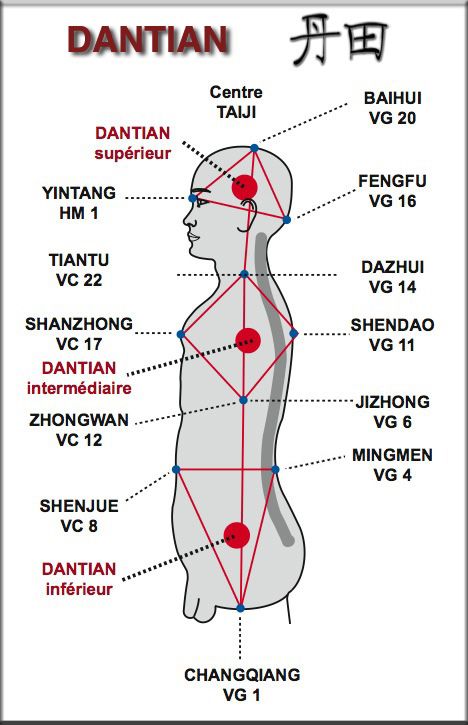


🔴 Layer A — Micro-core inside the dantian(丹田中一點)
Function: intent, direction change, timing
This is not anatomical
It is the point where 意 (yi) turns
It can “move” forward / back / left / right without visible motion
This is what people mean by:
“Inside the core, there is an even smaller core”
🔹 This layer initiates movement
🔹 It never produces force directly
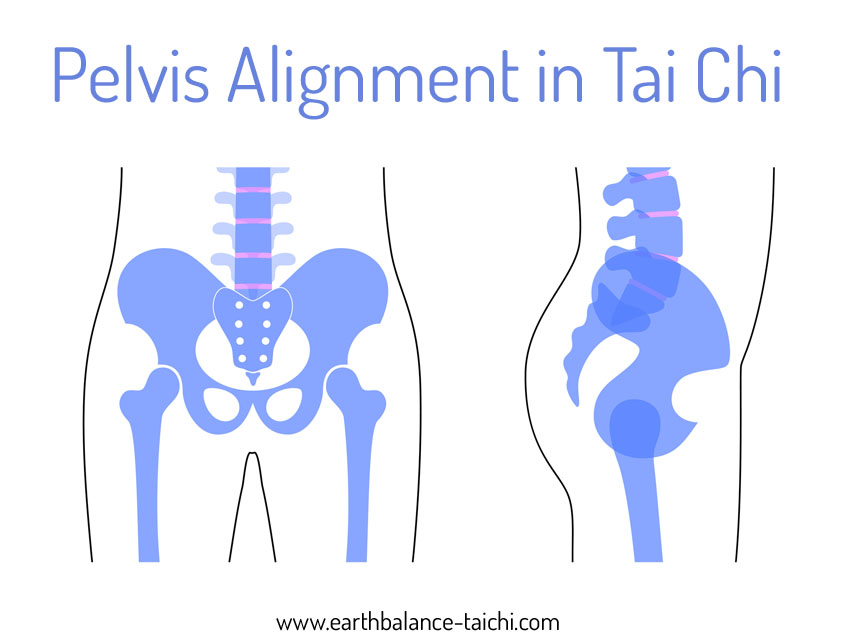
🟠 Layer B — Lower-body circle(兩腿+雙胯成圓)
Function: power generation, rooting, issuing force
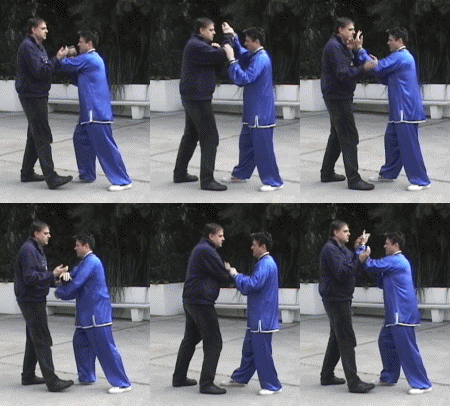
This is where the statement comes from:
“When pushing or pulling, the circle is formed by two legs and the hips; the upper body is not included.”
This is 100% correct because:
Jin (勁) must be:
rooted in the feet
rotated through the kua
If the upper body joins the circle mechanically:
shoulders stiffen
force leaks
structure breaks
🔹 This layer produces force
🔹 The upper body must stay song and neutral
🔵 Layer C — Whole-body qi sphere(全身氣球)
Function: integration, continuity, sensitivity
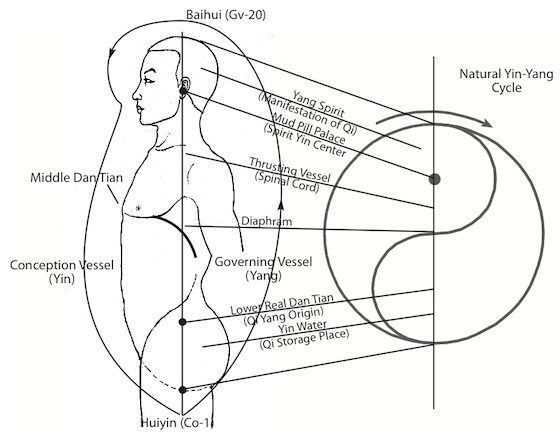

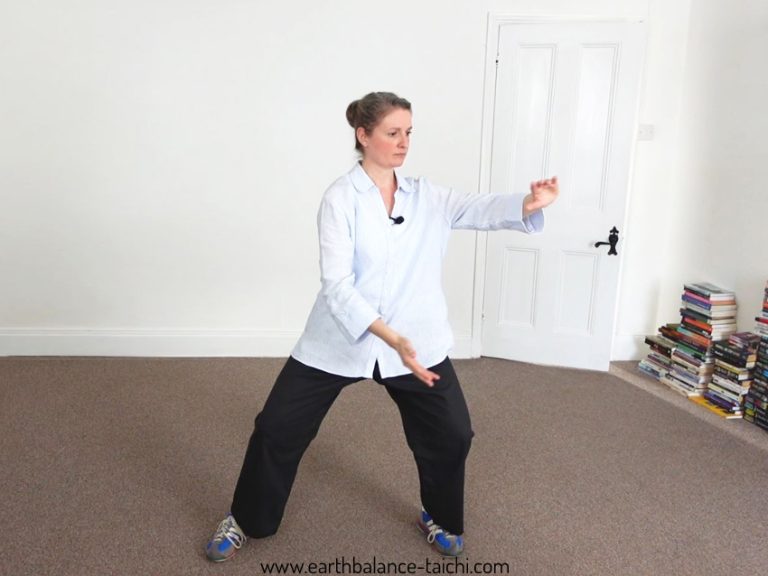

This is where people say:
“The whole body moves around the dantian.”
What it actually means:
Fascia, breath, and qi move as one field
Hands move because the body turns
Upper body is included internally, not mechanically
🔹 This layer connects everything
🔹 It transmits, blends, and neutralizes
3️⃣ How all three operate at the same time
When skill is correct:
| Aspect | What happens |
|---|---|
| Yi (意) | Turns in the micro-core |
| Jin (勁) | Generated in legs & kua |
| Qi (氣) | Circulates through whole body |
| Appearance | Upper body calm, lower body active |
This resolves the “contradiction.”
4️⃣ Why teachers emphasize different statements
Different teachings correct different mistakes:
| Teacher says… | They are fixing… |
|---|---|
| “Everything moves around dantian” | Disconnected arms |
| “Upper body is not included” | Shoulder force / arm pushing |
| “Dantian can shift” | Fixed center / stiff waist |
All are partial truths pointing to one system.
5️⃣ Classical Tai Chi logic (very important)
「一動無有不動,一靜無有不靜」
When one part moves, nothing does not move;
when one part is still, nothing is not still.
This only makes sense if:
mechanical roles differ
internal participation is total
6️⃣ Final verdict (clear answer to your question)
✔️ The “whole-body around dantian” view is correct
✔️ The “legs & hips circle only” view is also correct
❌ They are not alternatives
✅ They are different layers of the same art
True Tai Chi = one center, many circles, one body
In Tai Chi theory, these two concepts are not contradictory; rather, they describe different functional layers of the body's internal mechanics. To understand how they coexist, we have to look at the difference between Internal Circulation (Qi/Core) and Structural Rooting (The Base).
Here is how these two principles integrate into one system from Gemini:
1. The "Dantian" as the Gyroscope (The Engine)
Your description of the body moving around a "core within a core" refers to the Dantian (丹田). In high-level practice, the Dantian is treated like a 3D gyroscope or a ball bearing.
Small Core inside Large Core: This refers to the concentration of Yi (intent). While the physical abdomen moves, the "seed" of the movement is a microscopic point of origin.
The Function: The Dantian is the source of spatial orientation and spiraling energy (Chan Si Jin). It directs how the limbs move through space. If the Dantian doesn't rotate, the limbs are just "waving" without internal power.
2. The "Lower Circle" as the Chassis (The Transmission)
The circle formed by the two legs and the hips (often called the "Arch" or "Crotch Arch" / 圓襠 - Yuán Dāng) refers to your structural stability.
The Function: When you are pushed or pulled, you cannot rely solely on the Dantian's rotation, because the Dantian is "floating" in the center of the body. You need a way to transfer the opponent's force into the ground.
Why it excludes the Upper Body: This "lower circle" acts as the foundation. It creates a "hollow" or "arched" structure that allows force to pass from the ground, through the legs, and up to the waist without getting stuck in the joints.
3. Resolving the Contradiction: The "Axle and the Wheel"
Think of a high-end car.
The Dantian is the Engine/Driver: It creates the torque and determines the direction (forward, backward, left, right).
The Lower Circle (Legs/Hips) is the Chassis/Suspension: It handles the friction with the road (the opponent's push) and ensures the car doesn't flip over.
When you are pushed:
The Lower Circle (Legs/Hips) receives the force and roots it.
The Dantian (The Core) rotates to "neutralize" the direction of that force.
The Whole Body moves around the core to redirect the force back to the opponent.
The Key Realization: The Dantian governs the movement, but the Hips/Legs support the movement. If you only have the Dantian core, you have no power (no root). If you only have the leg circle, you are a rigid statue (no transformation).
4. The "Internal" vs. "External" View
The First View (Dantian): Describes the Internal Qi and the Will. It is how the movement feels from the inside.
The Second View (Leg Circle): Describes the Biomechanical Structure. It is how the body functions under external pressure.
Neither is incorrect; they are two parts of the same "Tai Chi Sphere." In advanced practice, the "Lower Circle" actually becomes the outer boundary of the Dantian's influence.
Summary Table
| Feature | The Dantian Core | The Lower Circle (Legs/Hips) |
| Role | Command & Rotation | Stability & Grounding |
| Action | Spiraling, Expanding, Contracting | Arching, Rooting, Bracing |
| Focus | Generating Power (Qi) | Transferring Force (Structure) |
| Metaphor | The Pivot of the Door | The Door Frame and Hinges |
沒有留言:
張貼留言