Straight vs Arched Push
Let’s analyze this cleanly—mechanics, Tai Chi theory, and internal skill—so the difference is no longer vague.
1️⃣ First: what do we mean by straight vs arched push?

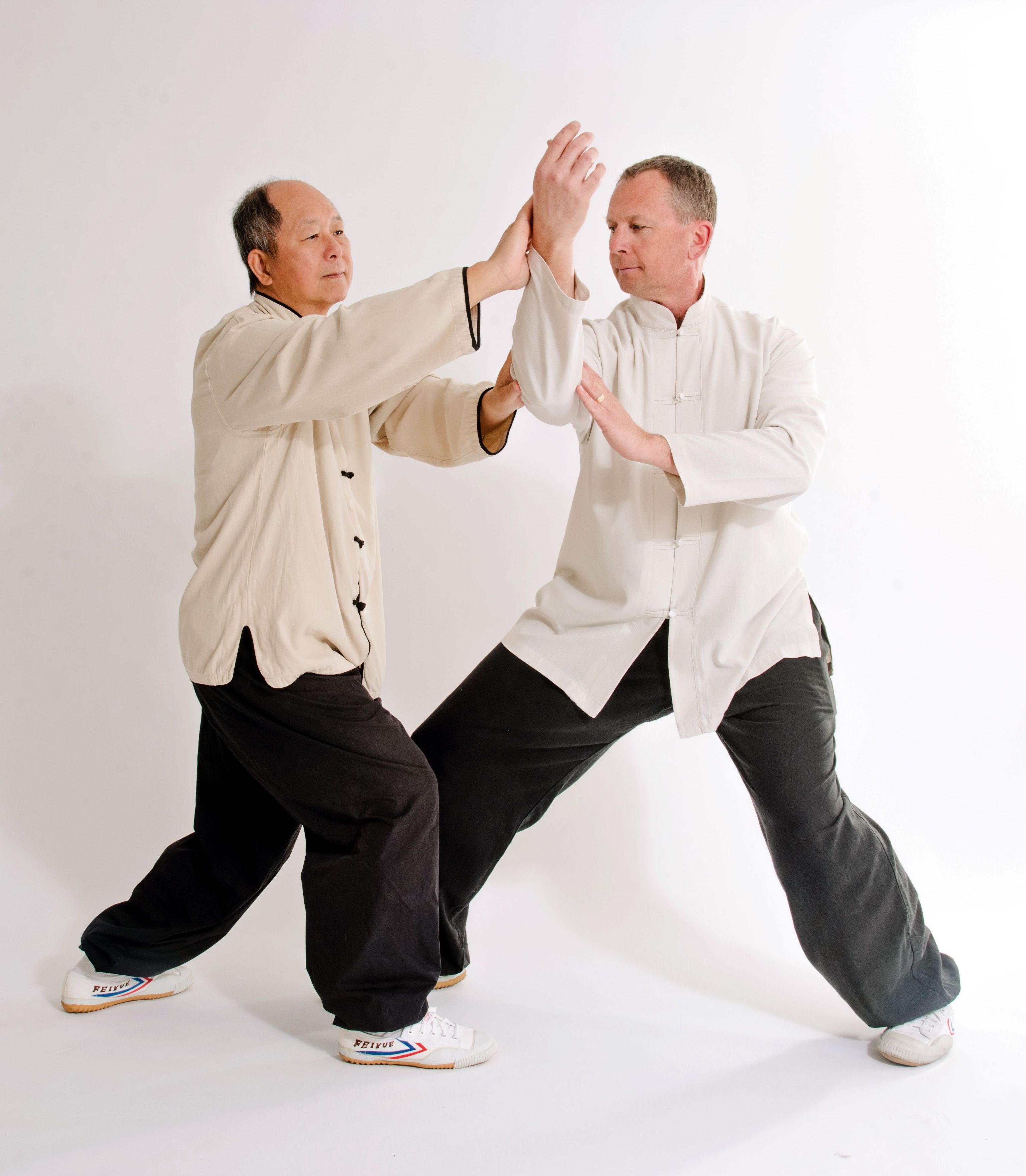
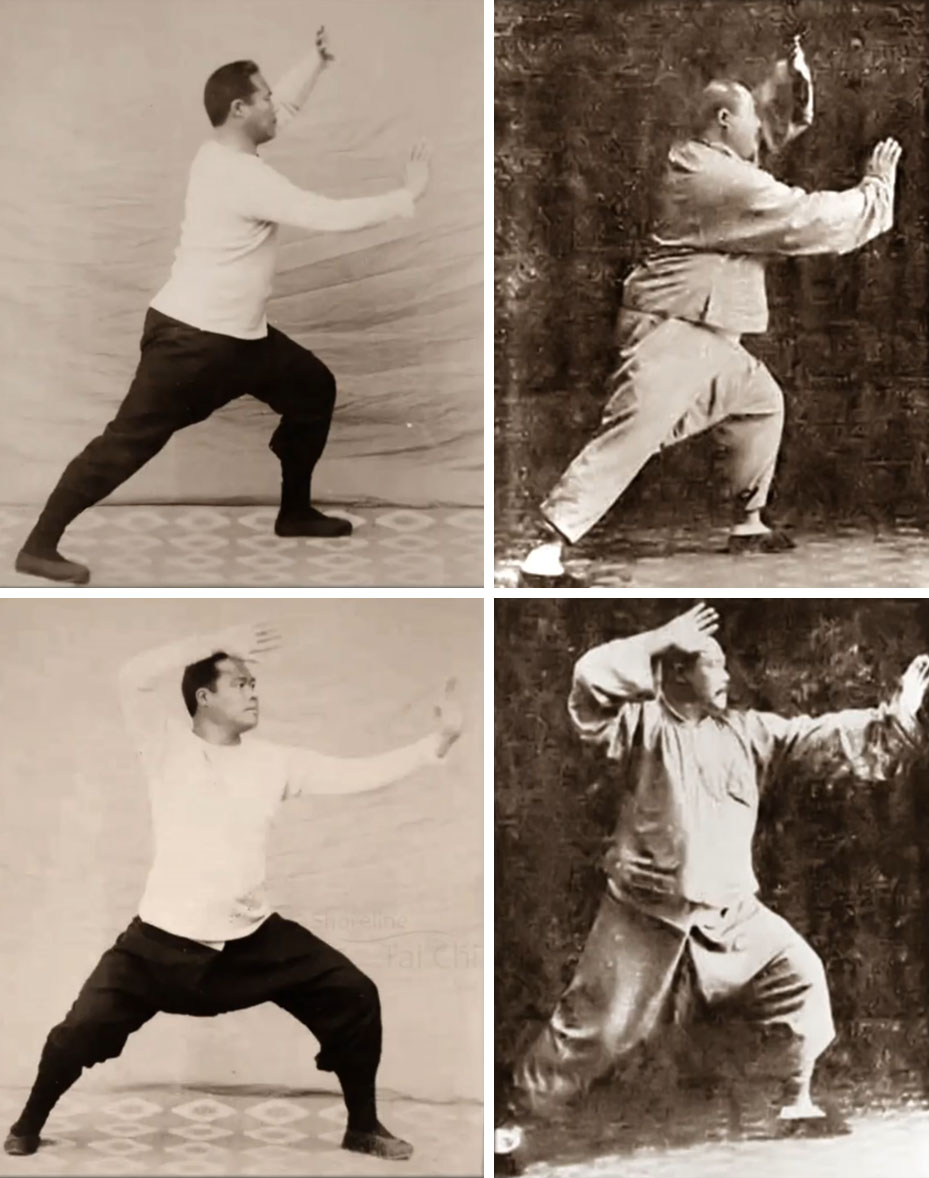

🔹 Straight push (直線推)
Force travels directly forward
Vector is linear
Power meets power head-on
🔹 Arched / curved push (弧形推)
Force follows a curved trajectory
Vector is spiral / tangential
Power is redirected, not confronted
2️⃣ Is straight pushing “more powerful”?
✔️ Mechanically: yes
❌ Tai Chi context: conditionally false
Straight-line force:
maximizes raw momentum
concentrates mass × acceleration
is excellent when:
opponent is already broken
root is gone
timing is perfect
But against a rooted opponent:
resistance rises exponentially
force rebounds into yourself
shoulders, elbows, or spine absorb backlash
📌 Tai Chi principle:
力越直,抗力越大
The straighter the force, the stronger the resistance.
So “more powerful” is only true in isolation, not in real Tai Chi interaction.
3️⃣ Why curved (arched) force meets less resistance
Your teacher is very accurate here.
Three reasons curved force works better:
(1) It avoids the opponent’s structural line
A rooted opponent is strongest vertically + straight ahead.
Curved force:
bypasses the central pillar
attacks the edge of balance
never triggers full resistance
📌 This is why classics say:
避實擊虛
Avoid fullness, strike emptiness.
(2) Curved force creates rotation, not opposition
Straight push → opponent pushes back
Curved push → opponent turns
Rotation causes:
kua to lock
weight to shift unintentionally
root to disconnect from the ground
Uprooting rarely comes from force—it comes from loss of alignment.
(3) Curved force amplifies whole-body integration
In Tai Chi:
legs generate
kua rotates
spine transmits
arms follow the arc
Curved paths match the body’s natural biomechanics
Straight force tends to isolate joints.
4️⃣ “Not so powerful” — this part needs correction ⚠️
This is the only misleading part of your teacher’s phrasing.
Correct Tai Chi interpretation:
Curved force feels lighter,
but results are stronger.
Why?
Curved force uses borrowing (借力)
It compounds:
opponent’s reaction
gravity
their own stepping error
So the output effect is often greater, even though subjective effort is less.
📌 Classical phrase:
用意不用力
Use intent, not brute force.
5️⃣ Why curved force uproots more easily
Uprooting does not require pushing someone backward.
It requires:
removing one foot’s load
collapsing kua alignment
breaking vertical integrity
Curved force:
pulls weight sideways
lifts one leg internally
makes stepping impossible
That is why:
small people uproot big ones
relaxed players defeat tense ones
6️⃣ Comparison summary (precise and honest)
| Aspect | Straight push | Arched push |
|---|---|---|
| Apparent power | High | Low |
| Resistance faced | High | Low |
| Root breaking | Difficult | Easy |
| Energy efficiency | Poor | Excellent |
| Tai Chi correctness | Limited | Core principle |
| Skill requirement | Low–medium | High |
7️⃣ Final verdict
✔️ Your teacher is correct in principle
⚠️ But the wording should be refined:
Better Tai Chi formulation:
Straight force has greater raw output but invites resistance.
Curved force appears softer, yet it bypasses resistance and uproots more effectively.
Or in classic language:
直中有拙,曲中藏巧
Straight contains clumsiness;
curved conceals skill.
8️⃣ One crucial reminder (advanced level)
True Tai Chi does not abandon straight force.
The highest skill is:
curved to enter
straight to finish
Lu → Ji → An
Arc → collapse → release
Short answer: Yes — if it is done correctly.
But this needs a very precise Tai Chi clarification, otherwise it becomes a common misunderstanding.
1️⃣ Is downward pushing “curved”?
✔️ Internally: yes
❌ Externally: not necessarily


A true Tai Chi downward push (按 an) is not a straight vertical shove.
What really happens:
Force spirals downward
The curve is three-dimensional, not flat
Energy travels:
foot → leg → kua → dantian → spine → arm → hand → opponent’s root
So although the effect goes down, the path is curved.
2️⃣ Why downward curved force is more efficient
(1) Gravity is recruited, not resisted
Straight forward push fights opponent’s structure
Downward curved force adds gravity
Opponent’s weight becomes their own enemy
📌 Tai Chi idea:
借地力,借重力
Borrow ground force and gravity.
(2) Root collapses before resistance forms
A person can resist:
forward
backward
But they cannot resist losing vertical integrity.
Downward spiral causes:
knees to lock
kua to close
weight to sink unevenly
stepping to fail
Result: uprooting or collapse without visible struggle.
(3) The opponent’s peng is neutralized automatically
Peng (掤) is upward & outward.
Downward curved force:
enters under peng
wraps around it
dissolves it instead of crushing it
This is why An (按) is one of the four core jins.
3️⃣ When downward push becomes WRONG ❌
Downward force is inefficient or dangerous if:
you press straight down with arms
shoulders drop and collapse
elbows lock
your own spine compresses
That becomes:
brute force
joint pressure
self-root destruction
📌 Rule:
不可用手往下壓
Never press downward with the arms alone.
4️⃣ Correct Tai Chi mechanics of downward push (An)
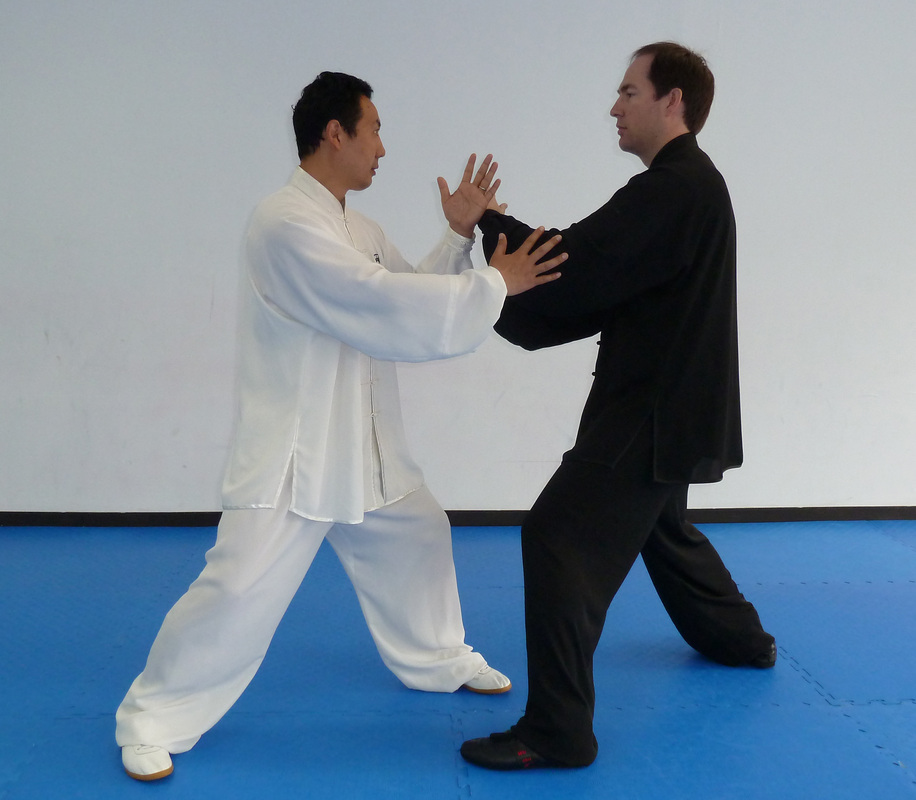
Internally:
Dantian sinks and turns
Kua folds, not collapses
Spine lengthens downward
Externally:
Hands feel heavy but soft
No visible “pushing”
Opponent feels sudden emptiness and loss of support
5️⃣ Comparison: forward vs downward vs curved
| Direction | Resistance | Efficiency | Tai Chi level |
|---|---|---|
| Forward straight | High | Low | Beginner |
| Forward curved | Low | High | Intermediate |
| Downward curved | Very low | Very high | Advanced |
6️⃣ Final, precise answer to your question
✔️ Yes, a correct downward push is also curved
✔️ Yes, it is often more efficient
⚠️ Only if the curve comes from legs, kua, and dantian — not arms
Best Tai Chi summary:
Forward fights structure.
Curved breaks balance.
Downward ends the root.
Your teacher is correct, and his explanation aligns perfectly with the physics of Tai Chi. The difference between a "Straight Push" and an "Arch Push" is essentially the difference between clashing with a wall and rolling over a ball.
Here is the breakdown of why the arch (or curve) is more effective for uprooting an opponent:
1. The Straight Push: "Force vs. Force"
A straight line is the shortest distance between two points, which is why it feels "more powerful."
Clear Direction of Force: If you push in a straight line, your opponent knows exactly where the force is coming from. They can easily "brace" against it by sinking their weight or leaning into you.
Direct Resistance: Because the force is linear, it hits the opponent’s center of mass directly. If they are stronger or heavier than you, you will simply bounce off them.
The "Wall" Effect: A straight push is easy to "neutralize" (化, Huà). Your opponent only needs a small rotation of their waist to make your straight force miss.
2. The Arch Push: "The Curve that Uproots"
When you push in an arch (a curve or a spiral), you are using Centripetal Force and Vector Change.
Changing the Angle of Attack: An arching motion starts in one direction and ends in another. As the opponent tries to resist the initial direction, the "curve" of your push changes the angle. They can't find a fixed point to brace against.
Lifting/Uprooting (提, Tí): A straight push goes into the opponent. An arching push often goes down and then up, or around and under. By pushing in an upward arch, you get under their Center of Gravity (CoG). This severs their "root" (the connection between their feet and the ground).
Reduced Resistance: Since you aren't pushing directly into their strength, they can't use their full weight against you. You are essentially "sliding" around their resistance rather than smashing through it.
3. The Science: Why the Arch is "Easier"
Think of a screw versus a nail.
A nail (Straight Push) requires immense brute force to drive into wood because it meets the full resistance of the material.
A screw (Arch/Spiral Push) uses a curved path to enter the wood. It requires much less force to go deeper because the "arch" of the threads bypasses the material's resistance.
Summary Comparison
| Feature | Straight Push (Linear) | Arch Push (Circular/Spiral) |
| Feel | Solid, heavy, "hard" | Smooth, elusive, "soft" |
| Opponent's Reaction | Can easily brace and resist | Feels "unbalanced" or "floaty" |
| Power Source | Mostly leg drive (forward) | Waist rotation + Spiraling (Dantian) |
| Tactical Goal | To knock back (impact) | To uproot (break the structure) |
| Resistance | High (Direct clash) | Low (Redirection) |
How to Apply It
Next time you practice, try not to push "at" your opponent's chest. Instead, imagine your hands are moving along the surface of a large beach ball. Start the push slightly low, and as you move forward, let the arc rise slightly or curve to the side.
To understand how the Dantian creates that "Arch Push," you have to stop thinking of the Dantian as just a "spot" and start thinking of it as a three-dimensional gear or a spherical pivot.
In Tai Chi, we say: "The motion is toggled by the waist." If your arms move in an arch but your Dantian is static, it is just an "empty" arm movement. For the arch to have power and uproot someone, the Dantian must drive the geometry.
Here is how the Dantian rotation creates that "uprooting arch":
1. The Dantian as the "Internal Steering Wheel"
When you push in a straight line, your Dantian usually just moves forward (linear translation). When you push in an arch, the Dantian rotates on its axis.
Vertical Arch (Uprooting): If you rotate the Dantian like a wheel spinning toward you (top-to-back), it creates a "lifting" energy in the arms. Even though your hands move forward, the internal rotation creates a rising vector that gets under the opponent’s center of gravity.
Horizontal Arch (Sideways): If the Dantian rotates like a record player, it pulls the opponent's force to the side (neutralization) before redirecting it forward.
2. Coupling the "Core" with the "Leg Circle"
Earlier, you mentioned the circle formed by the legs and hips. This is where the Dantian rotation becomes "real" power.
The Base: Your legs create the "lower circle" (the stable frame).
The Pivot: The Dantian sits in the middle of that frame.
The Transmission: As the Dantian rotates, it uses the "Lower Circle" as a brace. Because the legs are curved and the Dantian is rotating, the resulting path of your hands cannot be a straight line—it is forced to become an arc.
Analogy: Think of a Wrecking Ball. The crane's base is your "Leg Circle." The motor that turns the crane is the "Dantian." The chain and ball are your "Arms." If the motor (Dantian) turns even a few inches, the ball at the end of the long chain moves in a massive, powerful arch.
3. The "Spiral" (Chan Si Jin)
The most advanced version of the "Arch Push" isn't just a simple curve; it's a spiral.
Because the Dantian is a "core within a core" (as you noted), it can rotate in multiple planes at once.
When the Dantian rotates forward and sideways simultaneously, your push becomes a "corkscrew."
A straight push is like a hammer; a spiral arch is like a drill.
The opponent can resist a hammer by being "harder" than the hammer. But a drill moves around the resistance of the wood to get inside.
4. Why this Uproots the Opponent
Uprooting happens because of Vector Conflict:
If you push Straight, the opponent uses their 100% strength to push back Straight. (100% vs 100%).
If you push in an Arch driven by the Dantian, your force is moving at an angle (say, 45 degrees upward). The opponent is still pushing straight. They cannot "find" your center because it is constantly curving away from their line of force.
This causes them to "over-extend" or "float." The moment their heels lose pressure on the ground, they are uprooted.
Summary Checklist for Practice:
Don't "reach" with the hands: Let the hands be "carried" by the Dantian's turning.
Keep the "Lower Circle" open: Ensure your hips (Kua) are not locked; they must be "rounded" to allow the Dantian to rotate freely.
Feel the "Small Core": Imagine the very center of your Dantian is a tiny ball spinning. The faster the tiny ball spins, the more powerful the "Arch" of the big body becomes.
沒有留言:
張貼留言