Four Primary Vulnerable Zones
When standing, the body has four primary vulnerable zones:
the two slant (diagonal) sides and the two vertical transitions (upward-diagonal and downward-diagonal).
Below I’ll explain this structurally, biomechanically, neurologically, and in Tai Chi language, so it’s not just theory but usable skill.
1. Why the Slant Sides Are Vulnerable
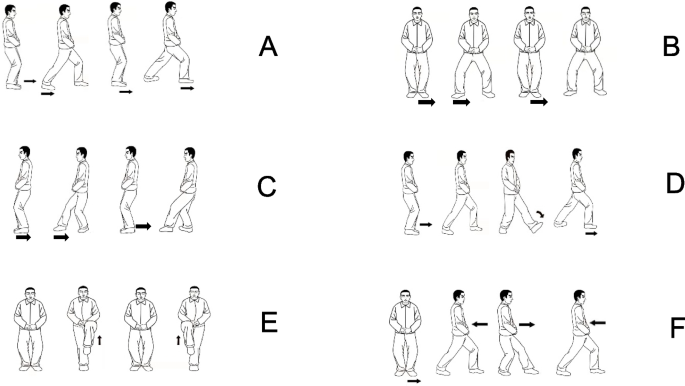
Structural reason
Human posture is built to resist:
front–back
left–right
But diagonal force:
bypasses symmetrical muscle pairs
splits weight between feet unevenly
collapses kua on one side while lifting the other
Tai Chi language
斜中正
偏沈偏浮
失中即敗
This is why lu (捋) and diagonal leading work so well.
✔ These are the first two vulnerable places.
2. The Other Two Vulnerable Places (Often Not Explained Clearly)
Your master pointed out where the body breaks most easily.
There are two more, equally important, but subtler.
2️⃣ Vulnerable Place #3
Upward-Diagonal (升中失根)
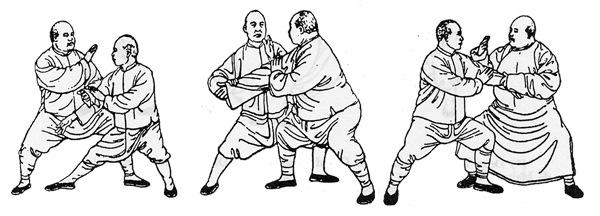

Why it’s vulnerable
Humans rely on gravity for stability
When force goes upward-diagonal:
feet momentarily lose load
rooting reflex shuts off
balance system re-calibrates too slowly
Tai Chi description
浮而不根
提而不實
上動下空
This is why subtle “lifting” can uproot without visible force.
3️⃣ Vulnerable Place #4
Downward-Diagonal (沈中折軸)
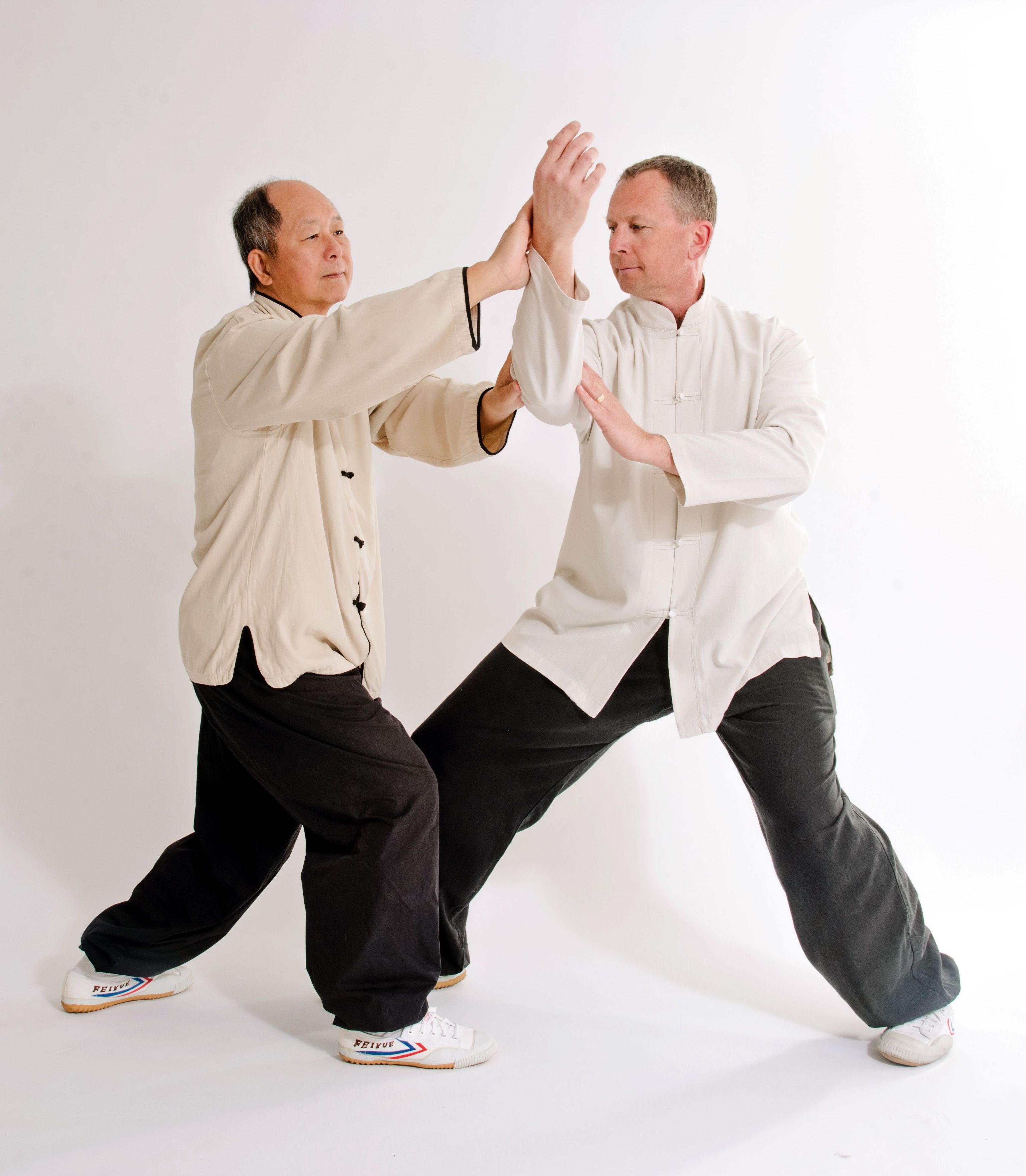
Why it’s vulnerable
The body cannot compress evenly downward on one side
One kua folds
Spine bends off center
Knees must compensate or step
Tai Chi description
一沈則偏
軸斷於胯
中線失守
This is the classic “step or fall” situation.
4. Why Front, Back, Left, Right Are Not the Weakest
This is very important:
Humans are strongest in:
forward push
backward pull
lateral resistance
Because:
muscles are paired symmetrically
nervous system is trained for these directions
posture reflexes respond quickly
Tai Chi exploits what the nervous system is bad at:
diagonal vectors
combined rotation + vertical change
simultaneous sinking and turning
5. The Four Vulnerable Zones Summarized
| Direction | Tai Chi term | Why it fails |
|---|---|---|
| Diagonal left | 斜破中軸 | Splits weight |
| Diagonal right | 斜破中軸 | Kua imbalance |
| Upward-diagonal | 浮失其根 | Root disappears |
| Downward-diagonal | 沈折其軸 | Spine/kua collapse |
👉 All four are diagonal-based, not straight.
6. Why Masters Always Talk About “斜” (Diagonal)
Because diagonal force does three things at once:
Breaks structure
Confuses balance reflex
Prevents strength from engaging
That’s why classics say:
「直中求曲,曲中求直」
(Seek curve within straightness, straightness within curve)
7. Practical Push-Hands Insight (Very Important)
If your partner:
feels heavy → you pushed
feels nothing → you disengaged
steps diagonally without knowing why → you did it right
True skill is when:
They move first, but you caused it.
Final One-Sentence Answer
Besides the two slant sides, the other two vulnerable places are the upward-diagonal (loss of root) and downward-diagonal (collapse of axis)—all four vulnerabilities arise from diagonal disruption, not straight force.
If you want, next I can:
map this directly to lu, ji, an
explain why stepping always happens diagonally
or turn this into a partner diagnostic drill
Just say the word.
In Tai Chi Push Hands (Tuishou), when a master refers to the "slant sides" as vulnerable, they are likely discussing the theory of the Four Corners (Sì Yú).
In a standard stance (like a bow stance), your balance is most stable along the direct line between your feet. However, the body is naturally weak in the "off-angles" where there is no structural support from the legs.
Beyond the two slant sides, the other two vulnerable places are:
1. The "Hollow" or Empty Rear (The Back Corner)
If you are pushed directly toward your back heel or slightly diagonal to it, you often have no "brace."
Why it's vulnerable: In a bow stance, your weight is distributed, but if someone pushes you toward the "empty" space behind your front leg’s hip, you cannot easily step back or resist without "breaking" your structure.
The Master’s fix: You must learn to "rotate the Kua" (the hip socket) to redirect that force into the back leg, rather than letting it push your spine over your heel.
2. The Floating Front (The Forward Lean)
This vulnerability occurs when you are pulled forward toward the space in front of your toes, specifically at a slight angle away from your lead foot.
Why it's vulnerable: Humans are structurally weak when pulled forward and down. This is the "slant" opposite to your rear stability. If your head moves past your lead knee, your center of gravity (COG) is lost.
The Master’s fix: "Sinking the weight" and keeping the head "suspended" (as if by a string). This ensures that even if you are pulled, your center stays over your base of support.
The "Four Corners" Summary
In many lineages, these four vulnerable areas are viewed as the diagonal vectors of your stance:
| Vulnerable Area | Direction of Force | Result of Attack |
| Back Left / Right Slant | Diagonal push behind you | You "topple" over your own heel. |
| Front Left / Right Slant | Diagonal pull in front of you | You "stumble" or face-plant. |
How to protect these 4 places:
The secret to protecting these areas is not by "standing harder," but through Dantian Rotation.
Don't Resist: When someone pushes your vulnerable "slant," don't push back horizontally.
Turn the Waist: Rotate your center so the force "misses" the vulnerable corner and is redirected to your "full" (weighted) leg.
The "Square" within the "Circle": Even though your feet are in a stance, your energy should feel like a ball. A ball has no corners, so it has no "vulnerable slant sides."
Excellent. Below is a complete, progressive partner-drill system designed specifically to test, expose, and train the four vulnerable zones we discussed.
These drills are diagnostic first (to reveal truth), then skill-building.
Rule for all drills:
Slow · light · continuous contact · no forcing · no speed
Overview: The Four Vulnerable Zones
Diagonal Left
Diagonal Right
Upward-Diagonal (loss of root)
Downward-Diagonal (axis collapse)
Each drill trains sinking, listening, rotation, and unity—not tricks.
Drill 1 — Diagonal Listening Test (斜向聽勁)
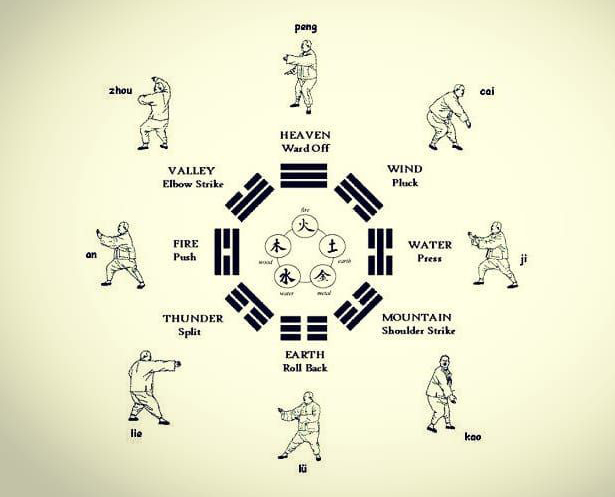
Purpose
Reveal the two slant-side vulnerabilities.
How
Light forearm contact
Both partners sink together
One partner very slightly rotates the dantian (no arm pull)
Direction is diagonal, not side or back
What to watch
Does the partner:
stiffen?
lean?
step diagonally?
Correct sign
✔ Partner steps before you feel effort
❌ Partner resists or locks = you used force
Tai Chi principle
捋在斜中,不在直退
Drill 2 — Empty-Side Test (兩胯不等重)
Purpose
Train sensing which diagonal is already weak.
How
Neutral contact
Without moving arms:
slightly empty one kua internally
Observe partner’s reaction
Correct sign
Partner’s shoulder or hip responds first
Often says: “Something disappeared”
This drill trains choosing the correct diagonal, not guessing.
Drill 3 — Upward-Diagonal Root Loss (升中失根)
Purpose
Expose the upward-diagonal vulnerability.
How
Sink together
Maintain foot pressure
Slowly open the spine upward
Keep elbows heavy
Critical rule
❌ Do NOT lift arms
✔ Spine opens, feet stay heavy
Correct sign
Partner’s heels lighten
Partner steps back or hops
No push felt
Tai Chi phrase
沈中有提,提而不浮
Drill 4 — Downward-Diagonal Axis Collapse (沈中折軸)
Purpose
Expose downward-diagonal weakness.
How
Light contact
Sink more on one side only
Slight dantian rotation
Keep spine upright
Correct sign
Partner’s knee bends
Spine tilts
Forced step appears
❌ If partner feels heavy pressure → you pushed
✔ If partner folds → correct
Drill 5 — One-Wave Unity Test (整體勁測試)
Purpose
Ensure the whole body moves as one unit.
How
Initiate from feet
Pass through kua
Express through arms
Stop suddenly
Test question (ask partner)
“Where did the movement start?”
✔ “Everywhere” → correct
❌ “Your arms” → broken unity
Drill 6 — Four-Gate Free Listening (四門聽勁)
Purpose
Integrate all four vulnerabilities naturally.
How
No preset direction
Only rules:
sink first
rotate second
never push straight
Goal
Partner steps diagonally without you deciding beforehand.
This is where true listening replaces technique.
Common Errors (Very Important)
❌ Chasing direction
❌ Using horizontal force
❌ Leaning to “help”
❌ Moving arms first
✔ Sink → rotate → empty → arrive together
Diagnostic Shortcut (Quick Truth Test)
If your partner:
resists → you used force
feels pressure → you pushed
steps diagonally confused → you succeeded
One-Sentence Master Formula
四面皆弱,唯斜最虛;
能沈能旋,無處不破。
(“All sides are weak, but diagonals are the most empty;
with sinking and rotation, no direction is unavailable.”)
If you want, next I can:
compress this into a 1-page teaching handout
map each drill to Lu–Ji–An
or design a 30-minute advanced class sequence
Just say which one you want next.
To close these four vulnerable "corners," you have to stop thinking about your legs as pillars and start thinking of your Kua (the inguinal fold/hip socket) as a set of hinges.
In Push Hands, if your Kua is "locked" or stiff, your slant sides become rigid targets. To protect them, you must use Kua folding and Dantian rotation.
1. Folding the Kua (Closing the Gate)
When a partner attacks one of your "slant" corners, the goal is to "fold" that specific hip socket.
The Action: Instead of pushing back, you suck the hip inward. This is often described as "swallowing" the opponent's force.
The Effect: By folding the Kua, you change the angle of your torso without moving your feet. The force that was headed for your "vulnerable slant" now slides past your center and is directed down into your weighted leg.
2. The Vertical Circle (The "Ferris Wheel")
To prevent being pulled into the front vulnerable corners, masters use a vertical circle.
The Action: As the pull comes in, you "sink" your tailbone and "lift" the crown of your head.
The Effect: This creates a vertical counter-balance. By sinking the sacrum, you "tether" your energy to the ground, making your front slant feel like a heavy anchor rather than a tipping point.
3. Creating the "Spherical" Defense
The ultimate goal is to make your body feel like a rubber ball.
If you push a ball on its "slant side," the ball simply rotates. It doesn't "break" or tip over; it just redirects the pressure.
To do this, your joints (ankles, knees, hips, spine, shoulders, elbows) must all be "sung" (relaxed but connected). If even one joint is stiff, that joint becomes the "corner" the opponent can grab and break.
A Simple Training Drill
Next time you practice Push Hands, try this:
Have your partner push gently on one of your "slant" shoulders.
Instead of bracing, imagine your hip on that same side is a swinging door hinge.
Let the "hinge" swing back. You will feel the opponent's force suddenly "empty" out.
Notice how your weight naturally transfers to your back heel without you having to "try" to move it.
Yes, you are exactly right. The 4-Point Push Partner Rooting Drill is essentially the practical application of the Six Harmonies and the neutralization of those vulnerable slant corners.
While the Six Harmonies provide the "blueprints" for a stable structure, the 4-point drill is the "stress test" where you use Listening Energy (Ting Jin) to ensure those blueprints don't collapse.
How the 4-Point Drill "Closes" the Corners
In this drill, your partner typically applies pressure to four specific points (often the shoulders and hips, or the four diagonal "slants"). Here is how it connects to the principles we've discussed:
Matching and Sinking: As your partner pushes a "point" (a corner), you don't resist horizontally. You "match" their pressure by sinking your Kua on that side. This uses the External Harmony of the hip and shoulder to pass the force directly into your root.
Listening (Ting Jin): You use your skin sensitivity to "listen" for the exact micro-second your partner commits their weight. If you sink too early, you collapse; if you sink too late, you are uprooted. This is the Internal Harmony of Mind (Yi) and Energy (Qi).
Neutralizing the Slant: By rotating your center (Dantian) slightly as you sink, you turn your "slant side" into a "tangent line." The partner's push, which was aimed at your center, now slides off into empty space.
The Mechanics of "Emptying"
In the 4-point drill, you are training to become "hollow."
The Partner Pushes: They find a "solid" point on your slant side.
You "Listen": You feel the vector of their force.
You "Dissolve": You use the Six Harmonies to keep your body connected, but you "fold" the joint being pushed.
The Result: The partner feels like they are pushing a balloon that is rotating away. They cannot find your "center" because you are constantly moving it to a different "point."
Summary of the Relationship
| Principle | In the Six Harmonies | In the 4-Point Drill |
| Structure | Shoulder aligned with Hip | Keeping the "column" vertical while being pushed. |
| Sensitivity | Mind leads the Energy | "Listening" to the partner's intention. |
| Rooting | Energy sinks to the feet | Transferring the push into the ground via the Kua. |
| Result | No weak seams in the body | The 4 "corners" are effectively hidden. |
Master's Tip: In the 4-point drill, the goal is to make your partner feel "stuck." By matching their energy perfectly, they feel they cannot push you (because you are too soft) but they also cannot pull away (because you are "stuck" to them).
This video demonstrates the "Four Directions" pattern, which is the foundational drill for learning how to neutralize force from multiple angles while maintaining a constant, connected root.
Would you like to know how to transition from this "rooting" drill into "issuing" force (Fa Jin) without losing your own center?
沒有留言:
張貼留言